
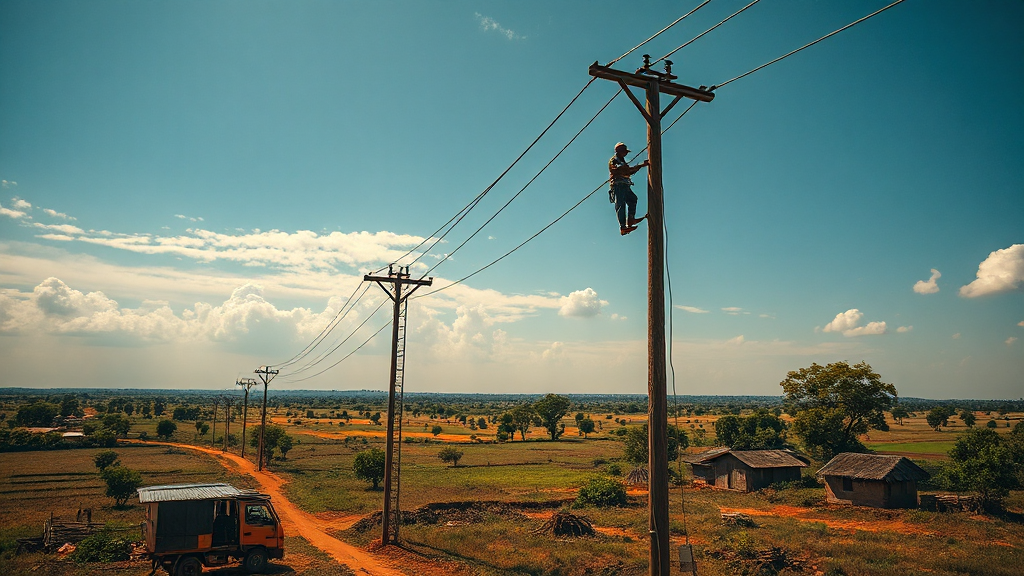
Kenya’s Rural Electrification and Renewable Energy Corporation (REREC) has confirmed the connection of 500 additional villages to the national electricity grid in the first half of 2026, bringing the total number of villages with grid access to approximately 12,400 — up from under 5,000 a decade ago. The accelerated pace of connection, funded through a combination of World Bank credit, African Development Bank grants, and the government’s Last Mile Connectivity Programme, is transforming daily life across some of Kenya’s most remote and historically marginalised communities.
“These are not statistics — they are dispensaries that can now refrigerate vaccines, schools that can run computers after dark, and mothers who no longer have to buy expensive kerosene for their children to study by,” said REREC Director General Joseph Njoroge at a briefing in Nairobi last month. “The grid is arriving in places where people genuinely thought it would never come.”
Where the Light Is Reaching
The 500 new villages span 34 of Kenya’s 47 counties, with the largest concentrations in the arid and semi-arid lands where population density and commercial returns have historically deterred private investment. Turkana County — Kenya’s largest and among its least developed — received 47 new connections in the current programme cycle, many of them in pastoral communities near the shores of Lake Turkana where diesel generation had been the only prior electricity source. Marsabit, Wajir, Mandera, and Tana River counties similarly feature prominently in the current tranche.
In the highlands and central counties, the focus has shifted from initial connection to quality and reliability. Kenya Power has, in parallel to REREC’s extension works, been investing in transformer upgrades and low-voltage network reinforcement to address the persistent voltage fluctuation problems that have frustrated businesses and households in areas connected in the early phases of Last Mile but never subsequently reinforced.
The Social Health Authority rollout has added fresh urgency to rural electrification. SHA-contracted health facilities are required to demonstrate a reliable power supply as a condition of their accreditation for reimbursement purposes — a provision that has made electrification a direct enabler of universal health coverage in rural settings. REREC reports that 63 health centres and dispensaries received connections as part of the 2026 programme, several of which had been operational for years without grid power.
Technology Mix: Grid and Off-Grid
Not all of the 500 villages are connected to the national high-voltage grid. In the most geographically isolated communities — those beyond economic extension distance — REREC has deployed minigrids powered by solar photovoltaic systems with battery storage, operating under a service delivery framework that provides electricity at nationally regulated tariffs rather than the premium pricing common in privately operated off-grid systems.
Some 68 of the new connections are served by solar minigrids, most of them in Isiolo, Samburu, and West Pokot counties. Each minigrid typically powers between 80 and 300 households, together with at least one community institution — a school, dispensary, or water pump. REREC has integrated Safaricom M-Pesa metering systems that allow households to pre-purchase electricity in daily or weekly tranches directly from their mobile phones, a feature that has dramatically improved revenue collection compared with earlier prepaid metering approaches.
The El Niño aftermath, which damaged roads and bridges across much of western and coastal Kenya in late 2023 and 2024, created logistical complications that delayed some 2025 programme targets into 2026. REREC and Kenya Power acknowledge that the pace of physical connection was disrupted by access difficulties in areas where roads were washed out, and that the 500-village figure partly represents catchup from the previous year’s shortfall.
Economic and Social Transformation
Field assessments from the Kenya Institute for Public Policy Research and Analysis, published in May, found that communities electrified under the Last Mile programme three or more years ago had experienced statistically significant improvements in school examination performance, small business revenues, and household income relative to comparable unelectrified control communities. Women entrepreneurs — particularly those running food processing, tailoring, and mobile phone charging businesses — were identified as the primary economic beneficiaries of reliable nighttime power.
The government’s target is to achieve universal household electricity access by 2030, a goal that requires connecting an estimated 1.4 million additional households beyond current coverage. At the current pace — accelerated by the expansion of geothermal supply giving the grid the generation headroom to absorb new load — that target is considered achievable, though funding continuity and the KRA’s tight fiscal environment under the IMF programme remain key risk factors.
For President Ruto, whose administration has staked significant political capital on the electrification agenda as a visible development dividend, the June announcement provides tangible evidence of progress ahead of a 2027 election campaign in which rural voter turnout will be decisive.

0 comments