
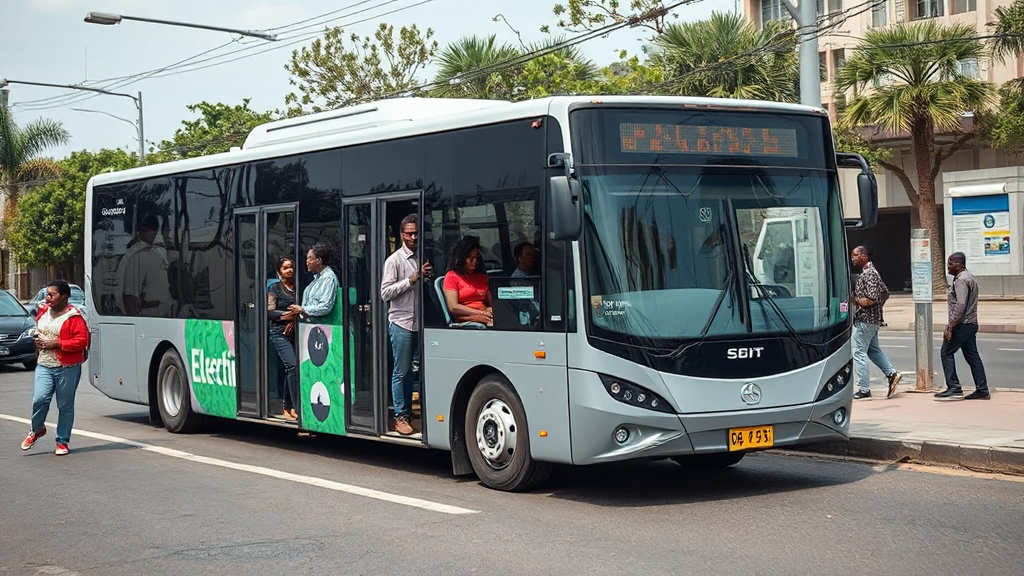
The Northern Commuter Transport Savings and Credit Co-operative Society — better known by its trade brand NorthLink — made history on 3 June 2026 when it placed the first fleet of fully electric passenger buses into commercial service on the Nairobi-Thika route, one of the capital’s busiest and most polluted transport corridors. The pilot, which involves 12 electric buses supplied by Chinese manufacturer Yutong and locally assembled battery modules from a partnership with Nairobi-based BasiGo, represents the most significant step yet in the practical decarbonisation of Kenya’s matatu and bus sector.
NorthLink Chairman David Ngunjiri said the SACCO had spent two years preparing for the transition, including sending a delegation to Shenzhen to evaluate Yutong’s transit solutions and working with BasiGo’s engineers to ensure that the battery management systems could operate reliably under Kenyan road conditions, which include significant altitude variation between Nairobi and the Thika plateau.
“We have been carrying passengers on this route for 22 years. Our members know every pothole, every traffic jam, every school rush. We know exactly what a bus on this corridor needs,” Ngunjiri told reporters at the launch event at the Bus Station in downtown Nairobi. “These electric buses meet every one of those requirements — and they cost us 40 per cent less to run per kilometre than our diesel fleet.”
The Vehicle and the Financing Structure
The 12 Yutong E12 buses on NorthLink’s service are 12-metre low-floor coaches with a range of approximately 300 kilometres on a full charge — more than adequate for the 48-kilometre Nairobi-Thika round trip that each vehicle typically completes four to five times per day. Air conditioning, USB charging points at every seat, and a passenger information display are standard on the NorthLink livery, differentiated from the SACCO’s existing diesel fleet to build brand recognition around the electric service.
Financing was structured through a green loan facility from Kenya Commercial Bank’s sustainable finance division, with a 15 per cent interest rate buy-down provided by a concessional guarantee from the African Guarantee Fund. The NTSA has, for the first time, applied a differentiated inspection and licensing regime for zero-emission PSVs, reducing the annual compliance cost for the electric buses by Ksh 85,000 per vehicle compared with diesel equivalents — a policy concession that the Kenya Bus Service Management Board lobbied for over 18 months.
BasiGo, the Kenyan e-mobility start-up backed by pan-African climate investment funds, provides the charging infrastructure at two purpose-built depots — one at the Thika end in Kenyatta Road and one at Ngara in Nairobi — and manages the battery lease arrangement under a pay-per-kilometre model that separates the battery cost from the vehicle purchase. BasiGo co-founder Jit Bhattacharya said the per-kilometre battery lease price had been set to ensure NorthLink’s total cost of operation was below diesel from day one. “We are not asking SACCOs to take a leap of faith. We have de-risked the economics so the decision is obvious,” he said.
Corridor Context and Passenger Response
The Nairobi-Thika route carries an estimated 180,000 passenger journeys daily across all modes, including matatus, standard buses, commuter taxis, and the recently extended commuter rail service. The corridor’s air quality has been a longstanding public health concern: roadside PM2.5 readings in Githurai, Roysambu, and Kasarani — the urban settlements the route traverses — consistently exceed WHO guidelines by a factor of three to five during peak hours, with diesel bus and matatu emissions a primary contributor.
Passenger response in the first weeks of operation has been enthusiastic, with social media posts and word-of-mouth generating waiting lists for the electric service despite NorthLink charging a Ksh 20 premium over standard diesel bus fares on the same route. The SACCO attributes the premium acceptance to perceived comfort, quieter cabin noise, and what Ngunjiri describes as the “pride factor” — a sense among younger Nairobi commuters, many of them shaped by the Gen Z civic awakening of 2024, of choosing a cleaner city.
Government Policy and Scale-Up Plans
The energy ministry’s new National EV Charging Network, also announced in 2026, provides further infrastructure support. However, for high-frequency transit operations, the SACCO model of dedicated depot chargers proves more practical than public network reliance. The National Transport and Safety Authority has signalled it will use the NorthLink data — covering energy consumption, charging cycles, brake wear, and passenger loads — to inform technical standards for the PSV electric vehicle category, which currently exists in regulation only in skeletal form.
BasiGo and NorthLink have already received expressions of interest from five other Nairobi SACCOs seeking to replicate the model on routes including Nairobi-Ngong, Nairobi-Kitengela, and the CBD-Westlands-Kikuyu corridor. If a further 60 electric buses enter service by end-2026, the combined fleet would represent a meaningful — if still modest — fraction of the approximately 7,000 buses estimated to operate in Greater Nairobi.

0 comments