
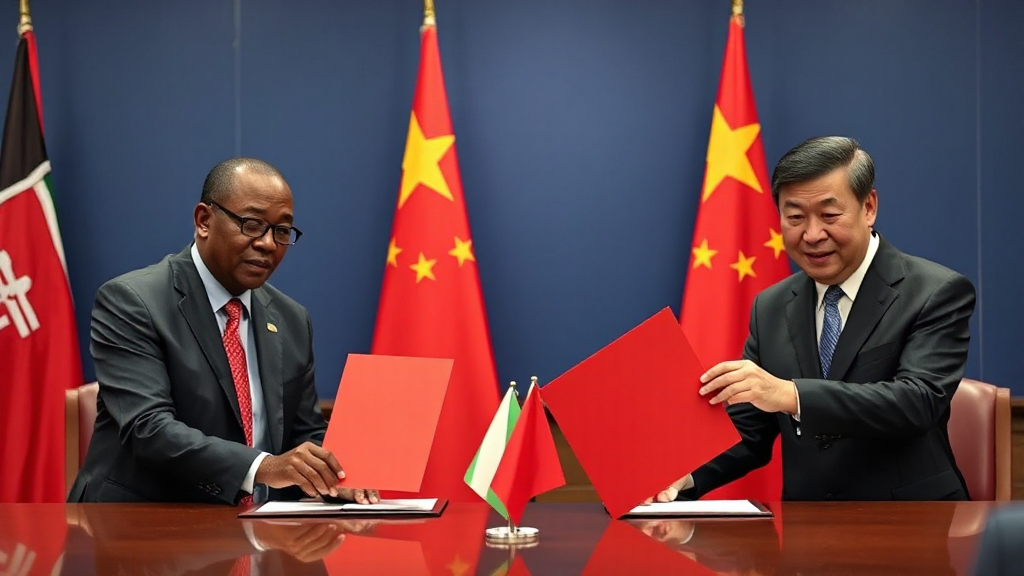
In a ceremony at State House Nairobi attended by Chinese Vice-Premier He Lifeng and senior officials from the Export-Import Bank of China, President William Ruto on Tuesday signed a financing framework agreement for the third phase of the Standard Gauge Railway, committing both governments to a $3.6 billion (approximately Ksh 465 billion) programme that will extend the line from its current terminus at Naivasha through Nakuru to the shores of Lake Victoria at Kisumu, covering a distance of 266 kilometres.
The agreement, described by Transport Cabinet Secretary Davis Chirchir as “a new chapter in the history of Kenya’s transport infrastructure,” has been in negotiation for more than two years, during which the Ruto administration sought to renegotiate terms inherited from the Uhuru Kenyatta era that Treasury officials had privately described as onerous. The finalised deal includes a 25-year repayment period at a concessional interest rate of 2.1 per cent — down from the 3.6 per cent applied to Phase 1 and Phase 2 financing — and a provision requiring at least 40 per cent local content in construction contracts, a significant departure from previous SGR agreements.
The Economic Case
The economic rationale for Phase 3 has strengthened considerably since the current SGR’s Mombasa-Nairobi and Nairobi-Naivasha segments began operations. Kenya Railways Corporation data released in May 2026 showed that the SGR carried 4.1 million passengers in the 12 months to April, a 62 per cent increase over the same period two years prior, while freight volumes on the Nairobi-Mombasa segment reached 6.3 million tonnes, representing 34 per cent of total port-hinterland cargo movement. Naivasha’s Special Economic Zone, a primary justification for Phase 2, has attracted 23 operational factories employing over 8,000 workers since the line’s extension opened.
The extension to Kisumu promises to unlock western Kenya’s economic potential more directly. The region — encompassing Kisumu, Kakamega, Vihiga, and Siaya counties, with a combined population of approximately 7 million — currently depends on an A1 highway notorious for its condition and a regional airport with limited capacity. CS Chirchir told journalists that freight projections for the Kisumu extension, particularly for agricultural exports from the Lake Basin and manufacturing output from Nakuru’s industrial zone, suggested the line would reach operational breakeven within eight years of full commissioning.
Debt and Scrutiny
The agreement has not been without controversy. The National Assembly’s Transport Committee chair, Sylvanus Osoro, raised concerns about Kenya’s total SGR debt burden, which including Phase 3 will stand at approximately $9.4 billion. “We are building a railway that future generations will be paying for long after its useful life,” Osoro told the House during a special sitting on Wednesday. Treasury Principal Secretary Chris Kiptoo responded that Phase 3’s improved concessional terms and the local content requirement represented a materially different class of financing from earlier phases, and that independent modelling commissioned by the National Treasury projected a positive fiscal return from the line within 15 years.
The IMF, whose programme with Kenya includes oversight of public debt metrics, issued a measured statement noting that the financing arrangement had been disclosed and assessed against Kenya’s debt sustainability framework, but urging the government to “maintain vigilance” on contingent liabilities.
Construction Timeline
Construction on Phase 3 is scheduled to commence in January 2027, following completion of engineering surveys and environmental impact assessment processes. The projected completion date for the full Naivasha-Kisumu segment is 2031, though CS Chirchir noted that the Naivasha-Nakuru stretch of 85 kilometres, which crosses less technically demanding terrain, could be operational by 2029. Chinese firm CRBC, which built the existing SGR segments, will lead construction in a consortium that must include locally incorporated subcontractors to satisfy the local content clause.