Peeping Through Windows and Chasing Stickers: How the World Cup Won Kenya's Heart
Every Kenyan football fan carries one — a first World Cup. Not necessarily the greatest tournament they ever watched, but the one that reached into their chest and planted something that refused to leave. The edition that turned a neighbour's television into an altar, that made the roar of a faraway crowd feel like it had always belonged to them.
Key points
- Many Kenyan fans experienced early World Cups by peeping through video hall windows or sneaking to neighbours' homes.
- Timothy Simwa watched his first World Cup in 2002 aged 11, slipping out during school hours to video halls with no admission money.
- The 2002 tournament was co-hosted by Japan and South Korea, with many matches falling during Kenyan school hours.
- Fans also recalled collecting player stickers found inside chewing gum wrappers as part of the World Cup experience.
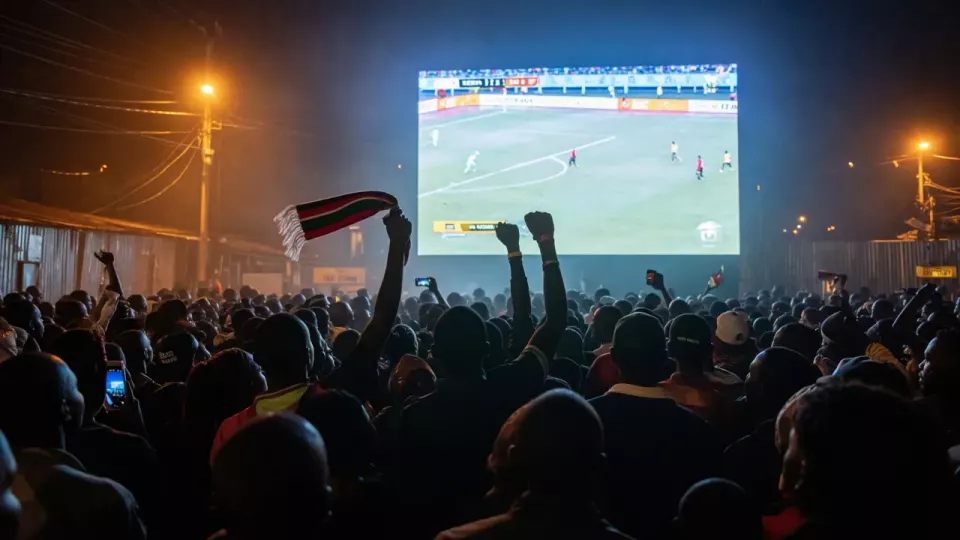
For many Kenyans who came of age in the late 1990s and early 2000s, the World Cup arrived not through a living-room flat screen but through ingenuity and sheer will — peeping through the windows of video halls, squeezing past adults twice their size, or sneaking down the road to an uncle's house where a small television glowed in the dark.
That is exactly how Timothy Simwa experienced his first unforgettable World Cup in 2002, when Japan and South Korea co-hosted the tournament and many of the matches fell squarely during school hours. Then eleven years old and in Standard Five, Simwa would slip away with friends to the nearest shopping centre, where video halls served as impromptu community cinemas. With no money for a seat, the boys made do — standing on tiptoe, wedging themselves between older viewers, pressing their faces to the glass for a glimpse of the action, according to Nation.Africa.
On the pitch, Brazil's Ronaldo, Ronaldinho and Rivaldo were electric. But it was Ronaldo's shaved-front, tufted haircut — worn in the final against Germany — that left the most improbable imprint on the country. Within weeks of the tournament ending, Nation.Africa reports, boys across Kenya were filing into barber shops with one request: the Ronaldo cut. A hairstyle born in a Brazilian dressing room had crossed oceans and continent to reshape the heads of football-loving children in Kenyan villages.
France 1998 cast its own quiet spell. Naftali Njoroge was a Class Seven pupil when that edition transformed him into a lifelong football devotee, as Nation.Africa recounts. He would slip away from home to watch matches at his uncle's house, where a black-and-white Great Wall television delivered the tournament's drama in grainy but gripping monochrome. What made that World Cup tactile as well as visual was a simple commercial idea: chewing gum whose wrappers concealed player stickers inside. Njoroge collected them methodically, pressing the faces of Ronaldo, Rivaldo, Roberto Carlos, Lilian Thuram and Dunga onto his mathematical set and school exercise books — a shrine built from sugar, foil and football devotion.
Those memories — the cramped video halls, the barber-shop queues, the sticker-covered textbooks — belong to a generation for whom the World Cup was never a passive spectacle. It was an active chase. Kenya has never qualified for the tournament, yet the passion has always arrived on schedule, transmitted through television signals, chewing gum wrappers and the collective electricity of crowds gathered around a single small screen.
The tournament changes shape and the technology changes with it. But the feeling of that first World Cup — the one that made you a fan before you had words for what you were becoming — that part stays.
Sources: Nation.Africa.