
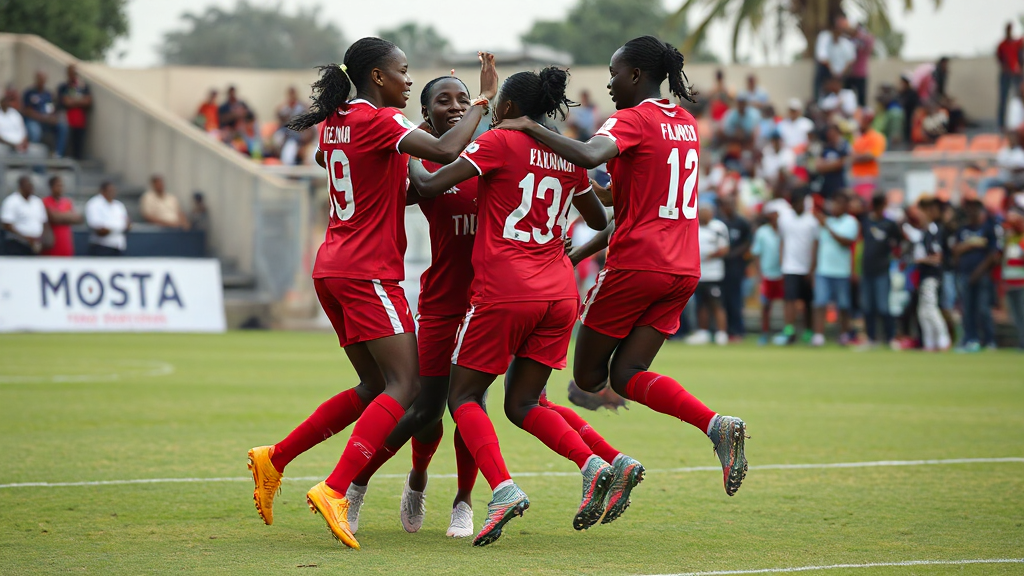
Harambee Starlets delivered a statement of intent for Kenyan women’s football with a 2-1 victory over Rwanda’s Amazons in the CECAFA Women’s Championship final at Mandela National Stadium in Kampala on Saturday evening. Goals from veteran striker Esse Akida, now 29 and playing some of the best football of her career in Iceland, and a second-half winner from 19-year-old midfielder Dorine Ouma sealed Kenya’s first CECAFA women’s title in four years and generated a level of domestic media coverage that underlined the sport’s growing profile in the country.
The path to the final had not been straightforward. Kenya were pushed hard in the group stage by Tanzania, required a penalty shootout to eliminate Uganda in the semi-finals, and entered the final against a Rwandan side that had defeated them in last year’s edition. Rwanda’s Amazons struck first through Gentille Iradukunda just before the half-hour mark, finishing clinically from a counter-attack that exposed Kenya’s high defensive line. The setback, however, appeared to galvanise rather than deflate the Starlets, who pressed relentlessly in the final fifteen minutes of the half and were rewarded when Akida equalised with a powerful header from a Mercy Achieng cross in the 43rd minute.
Ouma’s Winning Moment
The second half was tight, physical, and contested with a ferocity that reflected the rivalry between the two nations across East African women’s football. Head coach Alex Alumira, the Ugandan tactician retained by FKF after guiding the Starlets to WAFCON qualification in 2022, made a crucial double substitution in the 58th minute, introducing Ouma and forward Janet Anyango for the tiring Vivian Nasaka and flank player Cynthia Shilwatso. The change altered the game’s tempo immediately. Ouma, a product of Vihiga Queens’ youth academy who recently received a scholarship to train with a professional academy in Portugal, took control of midfield and created three of Kenya’s four most dangerous chances in a twenty-minute period.
The winner came in the 74th minute. Ouma received the ball on the left flank 25 metres from goal, cut inside onto her stronger right foot, and curled a shot that deflected off the outstretched boot of Rwanda defender Liliane Mukandayisenga and into the net. Rwanda pressed hard in the final quarter but found goalkeeper Annette Kundu equal to everything they could produce, the Oserian FC shot-stopper making two outstanding saves in the dying minutes.
Growing Pains and Greater Ambitions
The CECAFA title carries weight beyond regional bragging rights. Kenya’s women’s team begins its 2026 WAFCON qualifying campaign in September, and the tournament in Kampala will have served as essential competitive preparation across a squad that blends experienced professionals with emerging talent. FKF vice president for women’s football Patricia Ingutia said the federation’s intention was to replicate for women’s football what the men’s national team coaching structure had achieved under Engin Firat: stability, a defined playing philosophy, and long-term investment in players who might be ten years away from their peak.
The domestic Women’s Premier League has twelve clubs competing in 2026, up from eight three years ago, and attracts modest but growing crowds in Nairobi, Kisumu, and Mombasa. Sponsorship remains the structural challenge: the title sponsor deal that Safaricom signed in 2024 was a breakthrough but covers less than a third of the federation’s estimated operational budget for the women’s programme. Ingutia said talks were ongoing with two Nairobi-based brands seeking to align with women’s sports audiences. “These women sacrifice enormously,” Alumira said at the post-match press conference. “What they achieved tonight is bigger than the trophy. It is proof that when you believe in women’s football, women’s football delivers.”
The match was watched by an estimated 900,000 viewers on Kenyan television, a record audience for a women’s football match in the country and a data point that Ingutia said she intended to present directly to prospective sponsors. The comparison with 2022, when a similar CECAFA final drew approximately 200,000 viewers on the same channel, illustrates the pace at which women’s football is building its audience in Kenya, driven partly by the Starlets’ 2022 WAFCON campaign and partly by a broader cultural shift in how Kenyan sport media covers women’s competitions. Three major newspapers ran Ouma’s winning goal as their front-page sports photograph on Sunday morning, the kind of editorial recognition that both reflects and accelerates the growth of the game.

0 comments