Raila Odinga Returns from AU Commission Role with New Political Agenda
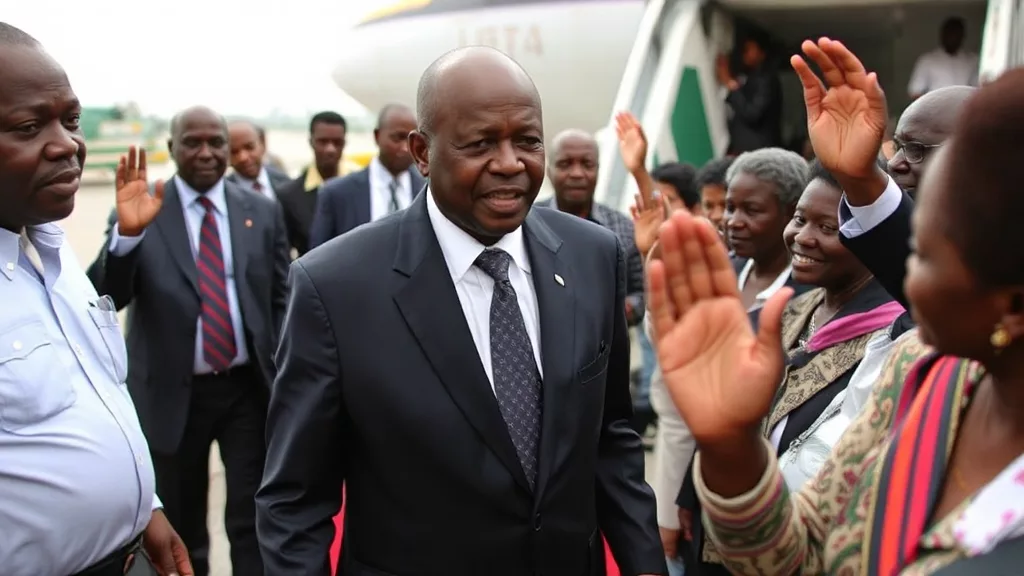
Raila Amolo Odinga touched down at Jomo Kenyatta International Airport on Saturday to a reception that blended the ceremonial enthusiasm of a returning statesman with the tactical curiosity of a political class eager to understand what the veteran opposition leader intends to do with the two years remaining before the next general election.
Mr Odinga, 81, spent the past 18 months as Kenya's candidate for the chairpersonship of the African Union Commission, a bid that ultimately fell short in the February 2025 election but nonetheless raised his continental profile and kept him substantively engaged with pan-African policy debates at the highest level. His return marks a pivot back to domestic politics at a moment of maximum uncertainty: President Ruto's administration is navigating IMF austerity, a resurgent youth political movement, and a 2027 election cycle that analysts describe as genuinely open.
What Raila Said at JKIA
Speaking to journalists from the tarmac of the VIP terminal, Mr Odinga delivered a prepared statement that was carefully calibrated to signal both continuity and reinvention. He called for a national conversation on constitutional reform, specifically the return of a prime ministerial position, the expansion of the Bill of Rights to include economic and social guarantees, and the creation of an independent fiscal council to audit government borrowing in real time.
"I have spent a year and a half working with African heads of state, finance ministers, and development banks. I have seen what governance can look like when institutions function. Kenya deserves nothing less, and I intend to advocate for that standard," Mr Odinga said.
He conspicuously avoided any direct statement about whether he would contest the 2027 presidential election, deflecting the question twice with the phrase "there is time for all things." The studied ambiguity was widely noted by political correspondents as characteristic of a politician who has lost presidential contests four times and is unlikely to make another bid without first assessing the landscape with great care.
Relations with Ruto and the Broad-Based Government
Mr Odinga's relationship with President Ruto is the central enigma of Kenya's current political moment. The so-called broad-based government arrangement, in which ODM joined the Ruto administration following the 2024 protests, has given Odinga's party several cabinet positions and a degree of influence over policy — but has also muddied the distinction between government and opposition that gives Mr Odinga his most potent political identity.
ODM's Secretary-General Edwin Sifuna, who accompanied the party leader to JKIA, said ODM remained committed to the broad-based government in principle but would be evaluating its continued participation on the basis of "measurable policy outcomes, not personal arrangements." The statement was interpreted as a signal that ODM is beginning to calibrate an exit from the arrangement as 2027 approaches.
Analyst Mutahi Ngunyi, speaking on Citizen TV's morning programme, suggested that Mr Odinga's most valuable strategic asset was precisely his ambiguity. "As long as Raila has not declared, he is relevant to everybody — to Ruto as a potential threat, to Kalonzo as a potential partner, to Martha Karua as a potential rival, and to the Gen Z movement as a potential elder statesman. The moment he declares, he becomes relevant to only some of those groups."
A New Economic Message
In a departure from previous campaigns, Mr Odinga's returning statement placed economic policy — particularly public debt, youth unemployment, and the cost of living — at the forefront of his agenda. Kenya's public debt stands at approximately Ksh 11.2 trillion, and the government's commitment to an IMF-imposed primary budget surplus has translated into visible service cuts that have fed public discontent.
"The generation that filled the streets in 2024 was not fighting for abstract freedoms. They were fighting because they cannot afford unga, they cannot find jobs, and they watch the government collect taxes to pay foreign creditors while hospitals run out of medicine," Mr Odinga said. The framing was a clear attempt to claim the Gen Z protest legacy — a move that PFK's founding chairperson Wanjiru Kamau immediately challenged on social media, writing: "You were not on the streets with us. The people who were are still here."
The exchange underscored the complexity of Kenyan opposition politics heading into 2027: the field is crowded, the youth vote is genuinely in play, and no candidate — including the most experienced political operator of his generation — can take the next two years for granted.