
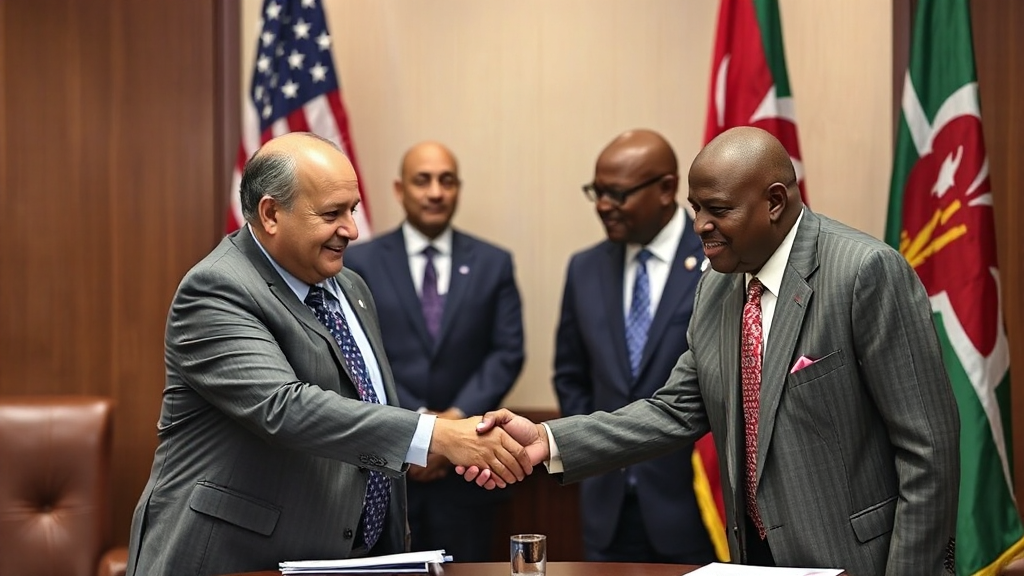
Trade negotiators from the Office of the United States Trade Representative and Kenya’s Ministry of Investments, Trade and Industry convened in Nairobi on Monday for the resumption of formal bilateral free trade agreement talks, ending a hiatus of nearly two years that had been attributed to shifting US domestic political priorities and Kenya’s own concerns about the pace of engagement. The resumption, announced jointly by USTR Katherine Tai’s successor Ambassador Marcus Webb and Trade CS Salim Mvurya, signals renewed political will on both sides for a deal that, if concluded, would represent the United States’ first bilateral FTA with a sub-Saharan African country.
The talks were originally launched in July 2020 under the Kenyatta administration and the first Trump term, generating considerable early momentum and seven rounds of negotiation before stalling in late 2024 following the US election cycle and Kenya’s own post-protest political turbulence. The joint statement issued on Monday described the resumption as reflecting “shared commitment to a comprehensive, high-standard agreement that supports inclusive economic growth, strengthens supply chains, and deepens people-to-people ties between our two nations.”
What Is on the Table
The scope of the agreement, based on previous rounds and the updated joint framework released on Monday, covers market access for goods and services, digital trade, intellectual property, labour standards, environmental provisions, and government procurement — a substantially broader remit than the sector-specific arrangements that characterise Kenya’s existing preferential access under the African Growth and Opportunity Act, which expires in 2025 and has operated under a series of extensions.
Kenya’s primary offensive interests in the negotiation centre on duty-free access for agricultural products including tea, coffee, fresh cut flowers, and processed horticultural goods, which currently face tariffs and sanitary barriers that Kenyan exporters describe as significant market constraints. The Kenya Flower Council estimates that preferential and barrier-free access to the US market could increase cut flower export revenues by up to 40 per cent within five years of implementation.
The United States’ interests, broadly speaking, focus on services market access — particularly financial services, telecommunications, and digital economy provisions — government procurement transparency, and stronger intellectual property enforcement, particularly for pharmaceuticals and technology products. US negotiators are also expected to push for labour and environmental standards that exceed Kenya’s current statutory framework, a demand that has historically generated pushback from local industry groups.
Domestic Concerns and IMF Dimensions
The negotiations are proceeding against a complicated domestic economic backdrop. Kenya’s ongoing IMF programme, whose eighth review was completed in May 2026, imposes fiscal consolidation requirements that constrain the government’s ability to offer transitional support packages to sectors exposed to import competition — a standard component of free trade agreement implementation. Several Kenyan manufacturers, particularly in the textile and footwear sectors, have expressed concern that duty-free access for US goods could undermine domestic industries that are still recovering from the combined effects of the COVID-19 era and post-El Nino commodity volatility.
CS Mvurya acknowledged the concern but argued that the overall balance of the agreement would favour Kenya. “We are not naive about the adjustments this will require,” he said at a press briefing. “But we are also clear that AGOA’s expiration and the restructuring of global supply chains make a modern, comprehensive trade relationship with the United States a strategic imperative, not a luxury.”
Timeline and Political Context
Both delegations have set an ambitious target of concluding substantive negotiations by March 2027 — a deadline driven partly by the recognition that Kenya’s general election campaign, expected to formally begin in mid-2027, will absorb political bandwidth and potentially shift policy priorities. Ambassador Webb noted that the US administration was “fully committed to the pace necessary to reach that objective.” Six technical working groups will operate in parallel between now and October, when a high-level ministerial review is scheduled. Whether the timeline proves achievable will depend significantly on the two sides’ capacity to bridge gaps on agriculture market access and labour standards — the same two issues that generated the sharpest disagreements in previous rounds.

0 comments