Invasive Water Hyacinth Chokes Lake Victoria, Threatening 200,000 Fishermen's Livelihoods
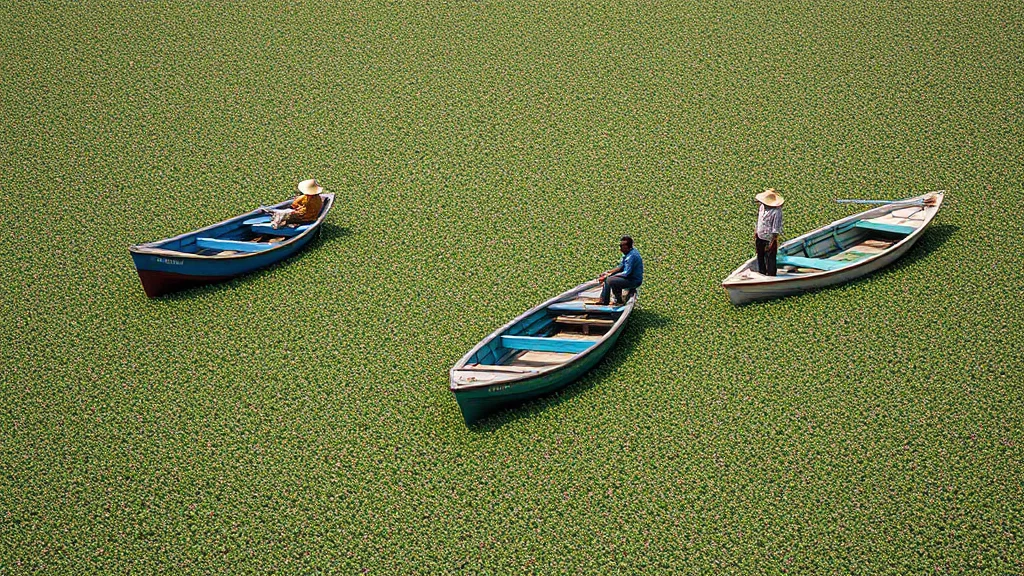
Water hyacinth, the free-floating South American plant that has plagued Lake Victoria since its accidental introduction in the 1980s, has staged a resurgence that authorities are describing as the worst infestation since 2006. Satellite mapping by the Regional Centre for Mapping of Resources for Development, published on 18 June 2026, identified 17,400 hectares of the lake's Kenyan waters covered by dense hyacinth mats — an area roughly equivalent to the size of Nairobi — with an additional 9,200 hectares affected on the Ugandan and Tanzanian sides of the shared lake. An estimated 200,000 Kenyan fishing households in Kisumu, Homa Bay, Siaya, Migori, and Busia counties depend on Lake Victoria for their primary income, and fishing communities report that boat access to open water has been cut off at 34 out of 63 monitored landing sites.
Water hyacinth (Eichhornia crassipes) thrives on nutrient-rich water, and Lake Victoria's nutrient load — driven by agricultural runoff from Kenya, Uganda, and Tanzania's expanding lakeside farming areas, discharge from Kisumu's incompletely treated sewage systems, and atmospheric nitrogen deposition from industrial and vehicle emissions — has reached levels that hyacinth finds near-optimal. The plant doubles its biomass every two weeks under ideal conditions, making control efforts a perpetual race against biological momentum. Climate factors have compounded the crisis: the calmer-than-normal lake surface winds recorded in the first half of 2026, a pattern linked to residual atmospheric disruption from the El Niño sequence, have prevented the wave action that historically fragments and sinks hyacinth mats.
The Human Cost on the Lakeshore
In Dunga Beach outside Kisumu, where tourism and artisanal fishing have historically combined to provide year-round income, fishermen report not having been able to launch boats for up to three consecutive days at the peak of the infestation in May 2026. James Ochieng Otieno, 44, who captains a five-man crew with two beach seine nets, told ZaKenya that his monthly income had fallen from Ksh 28,000 to under Ksh 8,000 since February. "We sit on the beach and look at a green field where the lake used to be. My children's fees are due. I have nothing."
The economic impact extends well beyond individual fishermen. Fish processing plants in Kisumu, which collectively employ over 12,000 workers and export Nile perch fillets worth an estimated Ksh 18 billion annually to EU and Asian markets, have reported a 35 per cent drop in raw fish throughput in the first half of 2026. The Kenya Fish Processors and Exporters Association has applied to the government for a Ksh 1.2 billion emergency working capital facility to avoid factory closures and mass redundancies before the infestation is brought under control.
Control Efforts and EAC Coordination
The Lake Victoria Basin Commission, the East African Community organ responsible for co-ordinating shared management of the lake, convened an emergency session in Kisumu on 20 June attended by environment ministers from Kenya, Uganda, and Tanzania. The session agreed to deploy mechanical harvesting vessels — nine currently operational across the three countries, with Kenya contributing four — in a coordinated formation targeting the densest mat areas at the Kenyan-Ugandan lake boundary, where transboundary hyacinth movement is most acute. The session also agreed to fast-track a $28 million World Bank-funded weed management project that had been stalled in procurement processes since 2024.
Biological control, using the South American weevil Neochetina eichhorniae that was introduced to Lake Victoria in the 1990s and provided a measure of long-term population suppression, has been undermined by the sheer scale of nutrient input. Experts from the International Centre of Insect Physiology and Ecology (ICIPE) in Nairobi are researching whether drone-based mass release of weevils bred in ICIPE's Kisumu satellite facility could supplement mechanical harvesting. An ICIPE trial in 2025 showed that weevil-treated hyacinth mats degraded 40 per cent faster than untreated controls, but scaling the approach to 17,000 hectares requires resources not yet committed.
The ultimate solution, ecologists agree, requires reducing the lake's nutrient load — which means investing in sewage treatment infrastructure in Kisumu and the dozen mid-sized lakeside towns in all three countries, and changing agricultural practices across the vast catchment. These are multi-decade propositions. In the meantime, the hyacinth continues to grow, two weeks at a time, while 200,000 Kenyan fishermen and their families wait for the lake to breathe again.