Nairobi River Restoration Project Clears 15 km of Urban Waterway
A stretch of the Nairobi River that has for decades been synonymous with Kenya's urban environmental failure has undergone a transformation that observers are calling unprecedented. The Nairobi River Restoration Project, a Ksh 3.4 billion initiative jointly funded by the Nairobi County Government, the national government's State Department for Environment, and the European Union, announced on 30 June 2026 that it had cleared 15 kilometres of the river channel — from Westlands Bridge downstream to the Ruaraka Road crossing — of solid waste, illegal structures, and encroaching riparian vegetation, removing 4,800 tonnes of solid waste and over 200 illegal structures in the process.
The Nairobi River is notoriously one of sub-Saharan Africa's most polluted urban waterways, carrying a toxic cocktail of industrial effluent from the Industrial Area, raw sewage from Kibera, Mathare, Korogocho, and dozens of other informal settlements, solid waste dumped directly into the channel, and chemical runoff from the city's vehicle repair workshops and battery recycling yards. A 2023 NEMA water quality assessment found zero dissolved oxygen in a 6-kilometre stretch near the Kenyatta National Hospital outfall, making the water biologically dead. Fish have been absent from the upper Nairobi River for over 30 years.
What the Clearance Involved
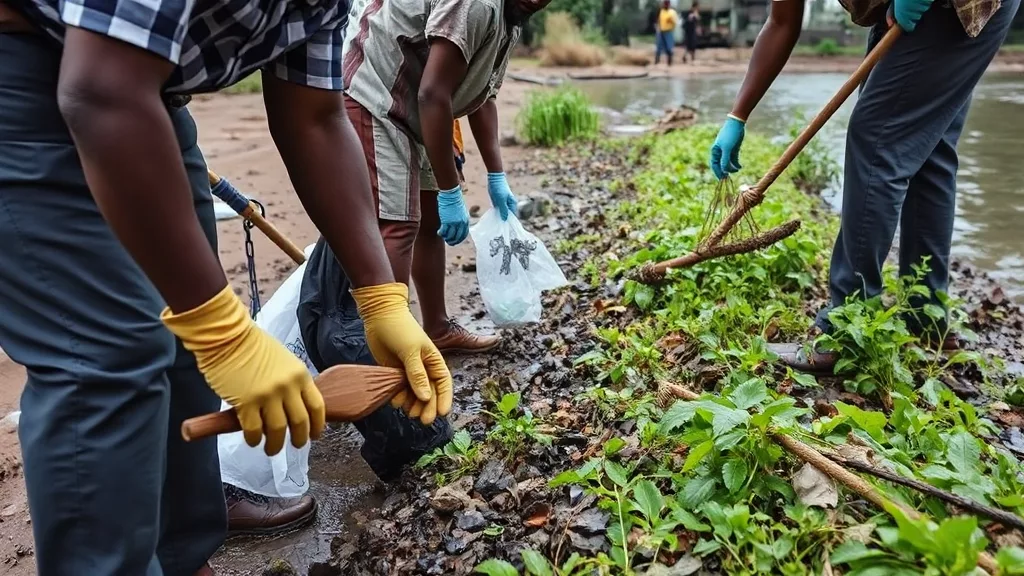
The restoration operation, which ran from October 2025 to June 2026, involved a coalition of 2,400 workers — including contracted civil engineering crews, Nairobi City County environmental officers, and over 600 community youth recruited from riparian settlements — clearing accumulated plastic, metallic waste, demolished structure rubble, and thick mats of invasive water hyacinth. Thirty-one heavy machinery units operated on coordinated eight-hour shifts to remove material from the channel bed and banks.
The 212 households and 47 commercial premises that had constructed within the 30-metre riparian reserve buffer were relocated under a resettlement programme coordinated with UN-Habitat's Kenya office. Each household received a structured resettlement package including alternative land titles in the Mavoko and Ruai expansion corridors and a cash transition grant averaging Ksh 180,000 per family, funded through the EU grant component. The process was contested — three court injunctions were filed by structure owners and resolved through mediation — but County Environment Executive Abdi Hassan described the legal process as "a testament that the rule of law, not bulldozers, drove this project."
Early Environmental Signs and Long-Term Vision
Within weeks of the channel clearance, environmental monitors recorded striking early recovery signals. Water turbidity in the cleared stretch dropped from an average of 1,200 NTU (nephelometric turbidity units) to 340 NTU by late June 2026. Dissolved oxygen levels rose from near-zero to 2.4 milligrams per litre — still below the 5mg/L threshold required for fish survival but a measurable biological shift. Twelve species of birds, including the grey heron and malachite kingfisher, have been photographed at riverside locations where none had been observed in living memory, according to Nature Kenya's Nairobi Urban Birding project.
The restoration plan extends well beyond physical clearance. NEMA has served enforcement notices on 89 industrial facilities discharging into the Nairobi River system without valid effluent licences, and the Capital Markets Authority has been asked to flag Environmental Social and Governance compliance failures to institutional investors in four publicly listed companies among the violators. The Dandora wastewater treatment plant, which was designed in 1980 to handle 80,000 cubic metres per day but currently receives 180,000 cubic metres, is undergoing a Ksh 8 billion expansion under a Japan International Cooperation Agency loan expected to complete by 2028.
Governor Johnson Sakaja, who made the Nairobi River restoration a flagship campaign promise in 2022, has staked considerable political capital on the project's visible progress. With the 2027 elections approaching, the 15-kilometre clearance milestone gives him a concrete, photographable achievement. Whether the river can be genuinely restored — ecologists say full biological recovery of even the cleared stretch requires elimination of upstream effluent inputs that remain active — is a question that will outlast any single political cycle. But for the first time in decades, Nairobians can walk the river's banks without turning away from what they see.