Kenya's Fish Farming Sector Grows 45% as Government Subsidises Pond Construction
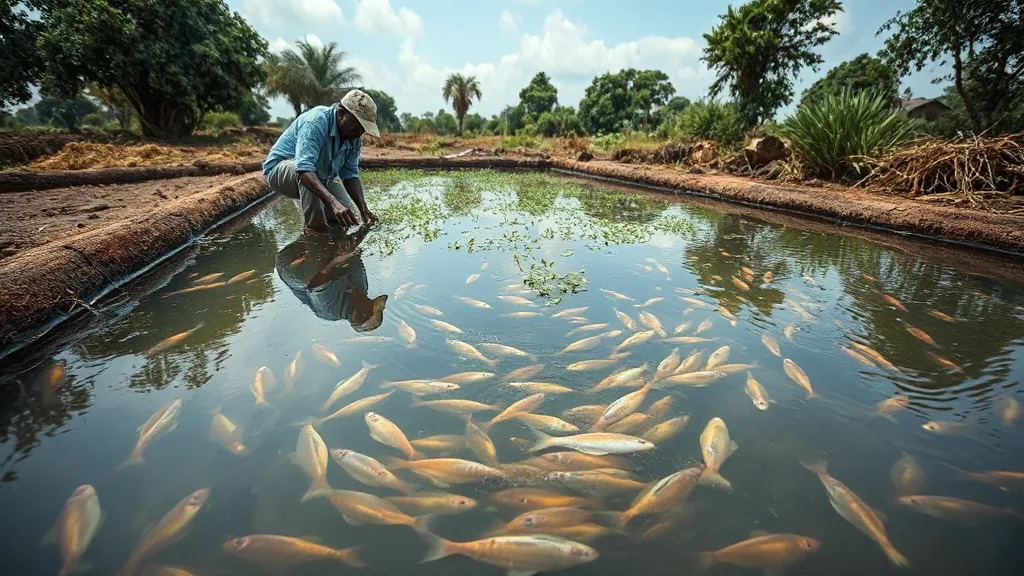
Kenya's aquaculture sector produced an estimated 82,000 metric tonnes of farmed fish in 2025, a 45 per cent increase over the 56,500 tonnes recorded in 2023 and the highest output in the sector's history. The leap, confirmed in a report released by the State Department for Blue Economy and Fisheries in May 2026, is directly attributable to an accelerated pond construction subsidy programme that has reached approximately 80,000 households across 35 of Kenya's 47 counties — and is beginning to reshape protein consumption patterns in areas far from the traditional fish-eating cultures of the lakeside regions.
How the Subsidy Works
Under the programme, administered jointly by the State Department for Blue Economy and county fisheries departments, qualifying smallholder farmers receive materials and technical labour support to construct a 300- to 600-square-metre earthen pond, along with an initial fingerling stocking of 2,000 Nile tilapia or catfish and a 90-day supply of commercial pellet feed. The government covers approximately 70 per cent of the construction cost, capped at Ksh 55,000 per pond, with the farmer contributing the remainder in cash or equivalent labour. Payments are processed through M-Pesa to county-registered contractors, a mechanism that programme managers say has significantly reduced the leakage that plagued earlier in-kind subsidy models.
"We learned from the failures of previous aquaculture programmes," said State Department Principal Secretary Rashid Mohammed at the report's launch in Nairobi. "The old model gave people fingerlings and feed and then disappeared. This model pairs infrastructure with a six-month extension support contract. We are seeing harvest rates above 70 per cent, which is very different from what we saw a decade ago."
Regional Spread and Nutritional Impact
While Kisumu, Siaya, and Homa Bay counties in the Lake Victoria basin remain the highest-volume production zones, accounting for about 35 per cent of national aquaculture output, the most striking growth has occurred in central and eastern Kenya. Kirinyaga, Embu, Meru, and Nyeri counties collectively increased aquaculture output by more than 200 per cent between 2022 and 2025. Catfish, which is more tolerant of variable water temperatures and lower dissolved oxygen levels than tilapia, has proved particularly successful in upland ponds. Nutritional surveys conducted by KEMRI in three aquaculture-dense counties found that households with active fish ponds consumed fish protein at least three times per week, compared with a national average of once per week for households at the same income level. Child stunting indicators in the surveyed areas showed a statistically significant decline over the two-year monitoring period.
Market Development and Export Potential
The rapid growth in production has begun to strain downstream infrastructure. Post-harvest losses from poor handling and the absence of refrigeration are estimated at 15 to 20 per cent of harvest weight. The Kenya Fish Processors and Exporters Association (AFIPEK) has urged the government to invest in village-level solar-powered chilling facilities as a priority. A small but growing number of farmers are partnering with urban-facing aggregators supplying supermarkets in Nairobi, Mombasa, and Kisumu. Naivas Supermarkets began stocking fresh farmed tilapia from a Murang'a County producer cooperative in early 2026, priced at Ksh 380 per kilogramme. Internationally, Kenya's Blue Economy strategy envisions fish exports of $200 million annually by 2028, a target that will require investment in certified processing facilities meeting EU and US food safety standards. Two facilities in Kisumu are currently undergoing HACCP certification audits — if approved, they would open European Union market access for the first time.