
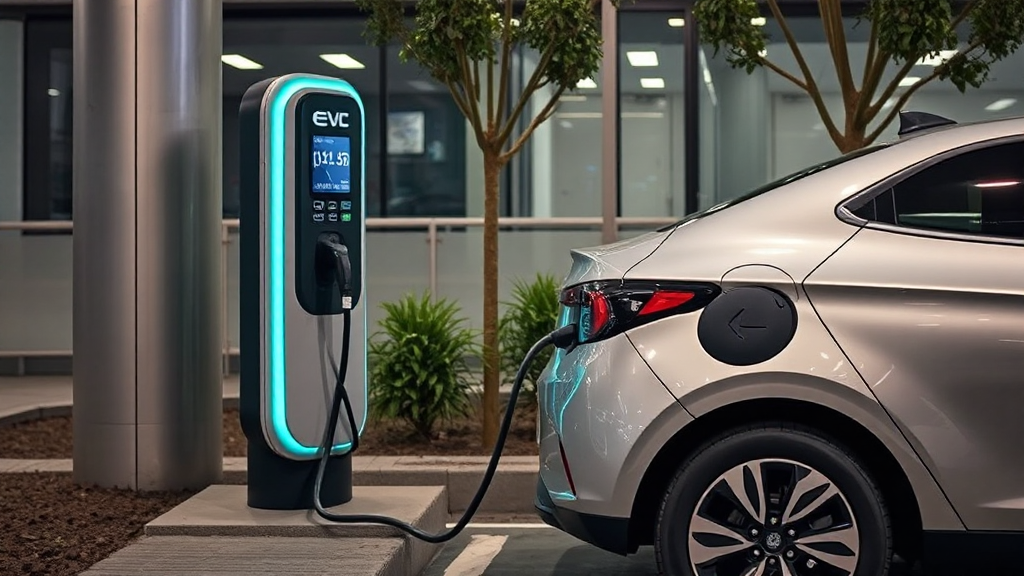
Kenya’s Ministry of Energy and Petroleum has unveiled a national electric vehicle charging infrastructure programme targeting 200 publicly accessible charging stations across the country by the end of 2027, in what officials describe as the most comprehensive EV infrastructure policy commitment made by any sub-Saharan African government to date. The programme, announced by Cabinet Secretary Davis Chirchir in a policy statement to Parliament on 18 June 2026, combines direct government capital investment, private sector franchise licensing, and a regulatory framework developed in close consultation with the electric mobility industry.
“Kenya has set a target for 30 per cent of new vehicle sales to be electric by 2030. That target is meaningless if drivers cannot charge their vehicles,” Chirchir said. “The charging network we are building is the enabling infrastructure — the road beneath the road — that will make EV adoption rational for ordinary Kenyans, not just for environmentally committed early adopters.”
Network Design and Station Locations
The 200 stations will be distributed across four tiers. The first tier covers the Nairobi metropolitan area, where 60 stations will be installed at a combination of public car parks, shopping centre forecourts, and government facility grounds in Nairobi, Kiambu, Machakos, and Kajiado counties. The second tier targets the Mombasa-Nairobi highway corridor, with DC fast chargers capable of delivering an 80 per cent charge in 30 to 45 minutes installed every 50 kilometres — addressing the range anxiety that highway travel creates for owners of smaller-battery vehicles common in the Kenyan market.
The third tier covers Kenya’s six other major urban centres: Kisumu, Nakuru, Eldoret, Thika, Nyeri, and Meru. Each will receive between five and 12 stations depending on population and projected EV uptake, with charging infrastructure co-located with existing fuel stations where site agreements can be reached. The fourth tier, explicitly developmental in character, targets 20 stations in county headquarters that currently have limited or no EV charging presence — including Garissa, Isiolo, Kitale, and Homa Bay — to signal that the EV transition is not limited to the urban middle class.
The Energy Regulatory Authority has published technical standards for the charging equipment, mandating compatibility with CCS2, CHAdeMO, and Type 2 AC connectors — the three standards that cover the overwhelming majority of EV models available in the Kenyan market, which includes growing imports of Chinese brands such as BYD, Changan, and MG alongside established Japanese and European electric models.
Financing and Private Sector Role
Government capital expenditure will fund the installation of the first 80 stations in tiers one and two, with a total public allocation of Ksh 4.5 billion across the 2026/27 and 2027/28 budgets. The remaining 120 stations will be financed and operated by private sector licensees under a franchise model, with the government providing a viability-gap subsidy per station of between Ksh 800,000 and Ksh 1.5 million depending on location tier.
Safaricom has already indicated its intention to integrate M-Pesa payment directly into the charging network’s mobile application, with a pilot underway at three Nairobi stations that allows drivers to initiate, monitor, and pay for charging sessions entirely through the M-Pesa super-app. The company is also evaluating a loyalty programme integration that would award Bonga Points per kilowatt-hour charged — a consumer incentive that Safaricom executives believe could meaningfully accelerate early EV adoption among the upper-middle-income demographic that currently leads uptake.
Kenya Power has been designated as the technical offtake partner for the network, responsible for metered supply connections and for ensuring that the charging stations receive power at the dedicated EV tariff — a new commercial category set at Ksh 15.80 per kWh, approximately 30 per cent below the standard commercial retail rate, in recognition of the predictable, schedulable nature of EV charging load that is beneficial for grid management.
Market Context and Challenges
Kenya’s EV market, while nascent by global standards, has been growing at a pace that surprised even optimistic industry forecasters. The Kenya Revenue Authority’s import data shows that 4,800 fully electric passenger vehicles were registered in Kenya in 2025, up from 1,100 in 2023 — a more than fourfold increase in two years. The government’s removal of import duty on electric vehicles in the 2023 Finance Act (the same bill that triggered the Gen Z protests before being withdrawn and subsequently replaced with a revised version) has remained in force and is widely credited as the primary demand driver.
Infrastructure challenges remain significant. The geothermal-dominated grid provides clean, cost-competitive power, but distribution reliability in some areas — particularly the peri-urban fringe where land for charging facilities is more available — remains a concern. Kenya Power’s technical losses of nearly 18 per cent represent wasted generation and create voltage instability that can damage fast-charger power electronics.
There is also the issue of the second-hand EV market. Most Kenyan buyers access vehicles through the used-import channel from Japan, and the availability of second-hand electric vehicles with degraded battery capacity has already generated consumer complaints. The Kenya Bureau of Standards is developing a battery health certification requirement for used EV imports, expected to be gazetted before the end of 2026.

0 comments