
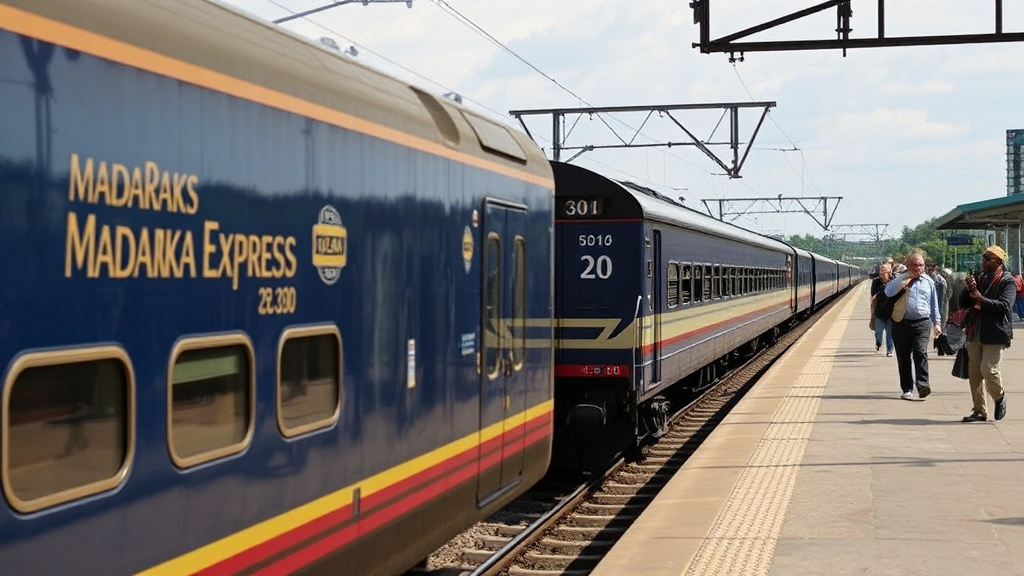
The Standard Gauge Railway’s Madaraka Express passenger service between Mombasa and Nairobi carried a record 8.03 million passengers in the calendar year 2025, according to official figures published by Kenya Railways Corporation in June 2026. The figure represents a 22 per cent increase over the 6.6 million passengers recorded in 2024 and a near-doubling of the service’s 2021 numbers, cementing the SGR’s status as the most commercially successful long-distance rail operation in East Africa and one of the few post-independence Kenyan infrastructure investments to have demonstrably exceeded its demand projections.
Kenya Railways Managing Director Philip Mainga said the milestone validated the controversial decision to build the SGR, which has been a subject of persistent public debate over its Chinese loan financing and debt service implications. “Eight million Kenyans chose the train over the road last year. That is the clearest possible market signal that this service meets a genuine need and is meeting it well,” he said at a press conference at Nairobi Terminus in Syokimau.
What Is Driving Demand
Several factors have combined to push passenger numbers to record levels. Fares on the Madaraka Express remain broadly competitive with road transport when travel time, safety, and fuel costs are factored in — the standard economy seat from Nairobi to Mombasa was priced at Ksh 1,000 for most of 2025, with a first-class seat at Ksh 3,000, against a typical bus or matatu fare of Ksh 700 to Ksh 900 for a journey that takes five to eight hours by road compared with the train’s consistent four hours and thirty minutes.
Safety has been a particularly significant driver. Kenya’s road fatality statistics remain grim — the National Transport and Safety Authority recorded 3,891 road deaths in 2025, many of them on the Nairobi-Mombasa highway, which is one of the country’s most accident-prone corridors. The complete absence of fatal accidents on the SGR since its launch has created a strong safety premium in the minds of Kenyan travellers, particularly families with children and business travellers for whom reliability matters.
Tourism recovery has also contributed substantially. International arrivals to Kenya reached 2.9 million in 2025, their highest level since before the COVID pandemic, with coastal tourism — Diani, Malindi, Watamu, and Mombasa itself — accounting for a growing share. The SGR’s direct connection from Jomo Kenyatta International Airport’s Syokimau terminus to Mombasa’s Miritini station has made it the preferred option for organised tour groups, with several major European and North American tour operators now building SGR segments explicitly into their itineraries.
Operational Improvements and Service Expansion
Kenya Railways has, over the past two years, incrementally increased train frequency on the corridor. Daily services now stand at six return trips in each direction — up from four in 2022 — with a seventh added on Fridays, Sundays, and public holidays to handle peak demand. An eighth daily service is under consideration for introduction in the third quarter of 2026, contingent on the completion of crossing-loop upgrades at three intermediate stations that constrain scheduling flexibility on the single-track sections of the route.
Cargo revenue on the SGR has also grown, with dry containers from Mombasa Port to the Nairobi Inland Container Depot increasing by 14 per cent in 2025 to approximately 340,000 TEUs. The combined passenger and cargo performance has, for the first time, brought SGR operations — though not debt service — into positive operating territory. Kenya Railways posted an operating surplus of Ksh 2.1 billion in the 2025 financial year, the first time the corporation’s accounts have shown a positive operating result since the SGR commenced commercial operations.
The Debt Question
The operating surplus, while commercially significant, does not touch the central financial challenge of the SGR: the Chinese Export-Import Bank loan that financed construction, estimated to carry outstanding balances of approximately $4.7 billion when Phase 1 (Mombasa-Nairobi) and the completed sections of Phase 2 (to Naivasha) are aggregated. Debt service payments — principal and interest — have been the single largest line item in Kenya’s bilateral debt obligations for several years, and the IMF programme’s debt sustainability framework has flagged the SGR loans as a key vulnerability in the country’s overall fiscal position.
Treasury officials argue that the revenue trajectory established by the 8 million passenger year, combined with the cargo performance, creates a credible path toward a commercialised SGR that can service its own debt without budget transfers. Sceptics note that even at current revenue levels, the gap between operating income and debt service remains large — and that Phase 2 extension to Kisumu, indefinitely paused for funding reasons, leaves the network at an economically suboptimal truncation point in Naivasha.
For ordinary Kenyans, however, those macroeconomic debates are somewhat abstract. The queues at Syokimau on a Friday evening tell their own story: the Madaraka Express has become a national institution, and 8 million passengers in a single year is proof that when public transport is safe, punctual, and affordable, Kenyans will use it.

0 comments