
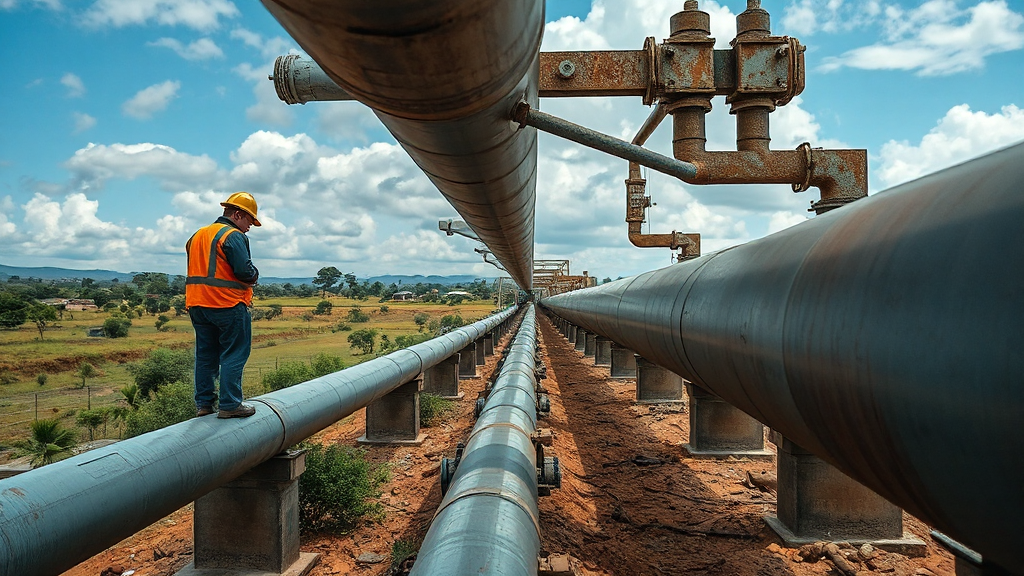
Kenya Pipeline Company (KPC) has completed a multi-year upgrade of its Line 1 pipeline running from the Kipevu Oil Storage Facility in Mombasa to the Nairobi depot at Embakasi, increasing the line’s sustained throughput capacity from 440 cubic metres per hour to 600 cubic metres per hour and adding three new intermediate pumping stations along the 450-kilometre route. The upgrade, which also involves lining 110 kilometres of the oldest sections of the pipe to address corrosion-related leakage losses, was completed in June 2026 at a total cost of approximately Ksh 28 billion.
KPC Managing Director Joe Sang described the project as the most significant investment in the pipeline’s physical infrastructure since the company commissioned Line 2 — the parallel high-speed line — in 2014. “Line 1 has been running since 1978. Parts of it are nearly 50 years old. The upgrade extends its operational life by at least 25 years and brings it to a standard where it can handle the growing fuel demands of not just Kenya but our landlocked neighbours who depend on the Mombasa corridor,” Sang told journalists at the Embakasi depot.
Strategic Importance in the Regional Fuel Supply Chain
The Mombasa-Nairobi pipeline sits at the heart of a fuel supply chain that serves not only Kenya but also Uganda, Rwanda, South Sudan, eastern Democratic Republic of Congo, and parts of Burundi and Tanzania — countries with a combined import volume that makes the Mombasa port-pipeline combination the most strategically consequential petroleum logistics asset in East and Central Africa. Any disruption to the pipeline’s throughput — whether through mechanical failure, vandalism, or scheduled maintenance — has historically caused immediate fuel supply tightening across the region, with price spikes and queues at petrol stations in Kampala and Kigali following within days of a Kenyan pipeline incident.
The 2023 and 2024 El Niño seasons created particularly difficult operating conditions, with several sections of the pipeline right-of-way in Tsavo affected by flash flooding that damaged protective berms and increased the risk of third-party interference. The lining works completed this year address the most vulnerable sections identified in a 2022 integrity survey commissioned following a major spill near Makindi that contaminated the Tsavo River and led to a Ksh 450 million environmental remediation liability for KPC.
Throughput data from 2025 showed the pipeline handled approximately 1.2 billion litres of refined petroleum products — petrol, diesel, kerosene, and aviation fuel — a figure that represents roughly 70 per cent of Kenya’s total liquid fuel supply (the balance arriving by road tanker, a more expensive and less efficient mode that KPC is explicitly trying to displace). At the upgraded capacity, the pipeline could theoretically handle up to 1.6 billion litres annually, providing a supply buffer that operators and the petroleum industry say will reduce the frequency of the supply crises that have periodically forced the Energy and Petroleum Regulatory Authority to intervene on pricing.
Automation and Leak Detection
Beyond the physical capacity upgrade, KPC has installed a new SCADA-based supervisory control and data acquisition system along the full length of Line 1, replacing the analogue monitoring equipment on the oldest sections of the route. The new system provides real-time flow and pressure data at 500-metre intervals, enabling the control room at Embakasi to detect and locate leaks within minutes rather than the hours that older monitoring allowed. The system is integrated with KPC’s emergency response protocols, including automatic valve closure upon anomalous pressure drop detection.
The Kenya Revenue Authority has been given read-only access to the SCADA throughput data as part of an anti-smuggling and fuel tax fraud initiative jointly developed with the Energy ministry. Petroleum tax evasion — which Treasury estimates costs the exchequer between Ksh 15 billion and Ksh 25 billion annually — has been a persistent problem along the pipeline corridor, and the real-time volumetric data is expected to significantly complicate the physical diversions that have historically evaded detection.
Extension Plans and Regional Ambitions
KPC is simultaneously advancing planning for the extension of its pipeline network to Uganda — the Eldoret-Kampala pipeline project that has been under discussion in various forms since the 1990s. A revised feasibility study, funded by the African Development Bank, is expected by the end of 2026, and KPC officials have indicated that the upgraded Mombasa-Nairobi line provides the foundational throughput capacity required to make the Uganda extension economically viable.
For the petroleum downstream sector, the upgrade also arrives at a moment of transition: Kenya’s long-term liquid fuel demand trajectory is uncertain given the government’s accelerating EV and clean cooking commitments. KPC’s own modelling projects that petroleum demand will continue growing at three to four per cent annually through 2035 before plateauing — meaning the upgraded pipeline will be fully utilised for at least the next decade regardless of the pace of energy transition.

0 comments