
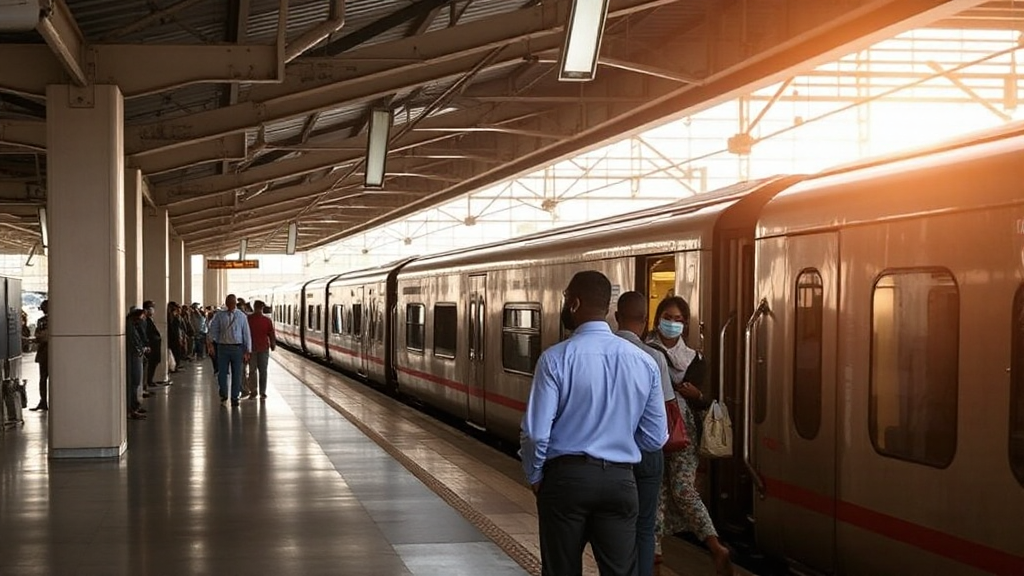
Nairobi’s long-beleaguered public transport system has taken a significant step forward with the formal commissioning of the northern commuter rail extension serving Ruiru and Juja — two of the fastest-growing peri-urban settlements on the outskirts of the capital. The service, which began commercial operations on 14 June 2026, carries passengers from Nairobi’s central Syokimau-linked corridor to refurbished stations at Ruiru town and the new Juja Farm halt, cutting journeys that can take up to two and a half hours by road during peak traffic to under 45 minutes by rail.
Kenya Railways Corporation Managing Director Philip Mainga described the opening as the single most consequential expansion to the urban rail network since the Syokimau terminal was rehabilitated in 2012. “We are connecting people who live 40 kilometres from the CBD but whose economic lives are in Nairobi. Every minute we save them on the commute is a minute they can spend working, studying, or with their families,” he told a crowd of several hundred commuters who turned out for the launch at the refurbished Ruiru station.
Infrastructure Investment and Service Design
The extension required Kenya Railways to rehabilitate approximately 38 kilometres of track on the former Nairobi-Nanyuki metre-gauge line, which had fallen into disuse for passenger traffic by the early 2010s. Works included the relaying of worn rail sections, the construction of two new sheltered platforms at Juja Farm and the upgrading of Ruiru’s existing station building, installation of modern signalling equipment compatible with the existing metropolitan rail management system, and construction of park-and-ride facilities accommodating 600 vehicles at Ruiru and 300 at Juja Farm.
The project was financed through a combination of a World Bank urban mobility loan facility that has also funded the Thika Road non-motorised transport lanes, a Ksh 3.1 billion government appropriation in the 2025/26 budget, and a commercial loan from Development Bank of Kenya. Total project cost came in at approximately Ksh 9.8 billion — substantially under the original estimate of Ksh 12.4 billion, a rare outcome in Kenyan infrastructure delivery that Treasury officials attributed to improved procurement oversight under the IMF programme’s public investment management conditions.
Services currently operate every 30 minutes during peak hours — 05:30 to 09:00 and 16:30 to 20:00 — and every 90 minutes at other times. A fleet of six diesel multiple units refurbished at Kenya Railways’ Nairobi South workshop handle the route, with fares set at Ksh 100 from Juja to Nairobi and Ksh 80 from Ruiru, payable through M-Pesa, credit/debit cards, or Safaricom’s Beba Card contactless transit token introduced across the metropolitan rail network in 2025.
Relief on the Northern Bypass and Thika Road
Traffic modelling by the Kenya National Highways Authority suggests the new service should divert between 8,000 and 11,000 private car trips per day from the Northern Bypass and Thika Superhighway during peak hours, reducing average vehicle speeds on those corridors — currently among the slowest in East Africa during morning rush hour — by an estimated 12 to 18 per cent. Matatu operators serving the Thika Road corridor have been less welcoming. The Matatu Owners Association of Kenya has petitioned the National Transport and Safety Authority to review the rail fares, arguing the subsidy implicit in the World Bank loan funding constitutes unfair competition with the privately operated public service vehicle industry.
The commuter rail expansion also intersects with Kiambu County’s spatial planning priorities. Governor Kimani Wamatangi has been a vocal advocate for transit-oriented development around Ruiru and Juja — two towns whose populations are estimated to have grown by more than 60 per cent since 2019, placing severe pressure on water, sewerage, and road infrastructure. The governor’s office is in discussions with the Kenya Railways Corporation and the Nairobi Metropolitan Area Transport Authority over zoning amendments to permit higher-density mixed-use development within 500 metres of both new stations, a model that has delivered affordable housing in Tatu City’s private development adjacent to the Ruiru orbit.
Looking Beyond Ruiru and Juja
Kenya Railways has confirmed that the next phase of the northern corridor — a proposed extension to Thika town — is under feasibility study, with a report expected by December 2026. Thika, home to a significant industrial base including the Thika Industrial Area and a growing tech and light-manufacturing corridor along the Eastern Bypass, would be a more commercially productive terminus than the current Juja Farm endpoint.
The Nairobi Metropolitan Area Transport Authority’s integrated transport plan, approved by Cabinet in 2025, envisages a comprehensive commuter rail network of 12 lines by 2035, with connections to the SGR at Syokimau, bus rapid transit corridors, and the proposed Nairobi Expressway feeder routes. The Ruiru-Juja opening is the first concrete proof of that vision becoming reality — and for tens of thousands of daily commuters from Kiambu County, it cannot come fast enough.

0 comments