How Circular Farming Is Turning Kenya's Market Waste Into Agribusiness Gold
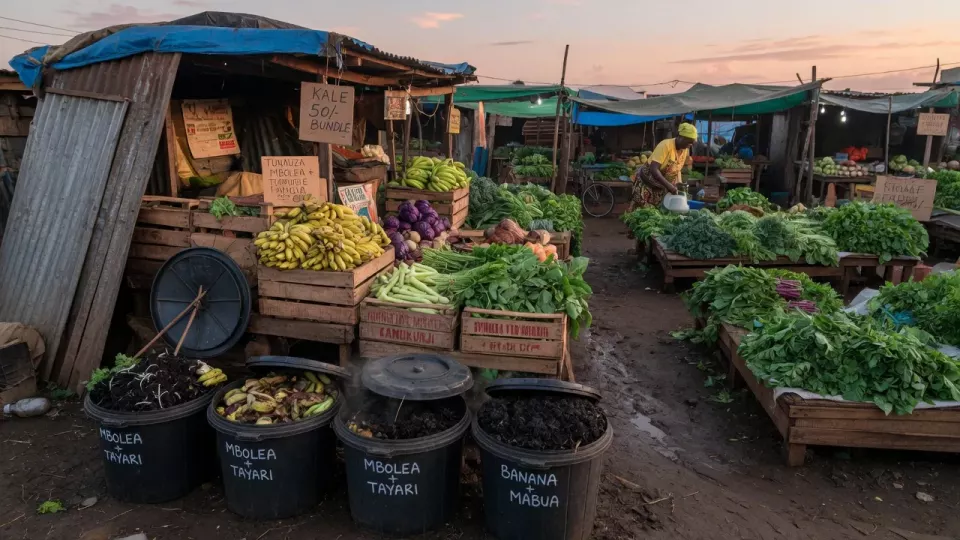
In Kenya's urban produce markets, an estimated 40 per cent of fruits and vegetables never reach a consumer — a figure that climbs to 60 per cent during rainy seasons when supply outstrips demand. Multiply that across Sub-Saharan Africa and the numbers become staggering: more than 174 million tonnes of organic waste generated annually, roughly three-quarters of it biodegradable and, crucially, recoverable. As reported by Nation.Africa's Seeds of Gold, experts say the moment to embrace circularity in Kenya's agri-food systems — keeping those nutrients in productive use rather than letting them rot in a landfill — has already arrived.
Key points
- An estimated 40% of Kenya's urban market produce never reaches consumers, rising to 60% in rainy seasons.
- Sub-Saharan Africa generates over 174 million tonnes of organic waste annually, roughly three-quarters recoverable.
- Circular farming methods cited include composting, vermicomposting, black soldier fly systems, and biogas production.
- Composting market waste into fertiliser reduces smallholders' dependence on expensive synthetic inputs, experts say.
From Dump to Soil Amendment
The most accessible entry point into circular farming is composting. Vegetable trimmings, crop residues, and market off-cuts can be processed into nutrient-rich organic fertiliser that reduces smallholders' dependence on expensive synthetic inputs and gradually rebuilds depleted soil organic matter. Vermicomposting accelerates this process through earthworms and yields a fine, fast-acting amendment particularly suited to kitchen gardens and smallholder plots.
The Black Soldier Fly Advantage
Among more technologically intensive options, black soldier fly (BSF) farming is attracting the most attention. BSF larvae consume organic waste with remarkable speed, leaving behind a high-quality frass that research has linked to suppression of soil nematode pests as well as improved fertility. The harvested larvae themselves become a protein-dense ingredient in rations for poultry, fish, and pigs — directly addressing one of the most persistent cost pressures facing Kenya's smallholder livestock keepers. Kenya's annual demand for BSF-derived animal feed is estimated at around 80,000 metric tonnes, yet domestic production currently meets barely one per cent of that potential, signalling the scale of the commercial opportunity on offer.
Waste as an Energy Source
A third avenue converts organic waste into bioenergy. Through anaerobic digestion, market and farm residues yield combustible gas suitable for cooking and heat. Gorge Farm Energy Park demonstrates what is possible at scale: the facility currently produces more than two megawatts of electricity and 4,000 cubic metres of cooking gas per day from animal waste, underlining that agri-circular energy models can move well beyond the pilot stage.
Jobs Along the Chain
Circular farming also creates employment in collection, sorting, processing, and distribution — roles that often align with the market positions of women and younger agripreneurs. The Waste to Wealth (WAWE) initiative, a 2024-to-2026 project funded by the Climate and Clean Air Coalition and implemented by the International Center for Tropical Agriculture across Nairobi, Kiambu, and Uganda's Soroti, is piloting inclusive business models designed to capture these opportunities for marginalised groups.
Experts tracking the sector caution that the main obstacles are systemic rather than technical: fragmented waste collection infrastructure, high upfront costs for BSF and biogas equipment, and uneven policy enforcement. Closing those gaps, they argue, is what will determine whether circular farming becomes a mainstream pillar of Kenya's agri-food economy or remains a promising experiment on its margins.
Sources: Nation.Africa.