
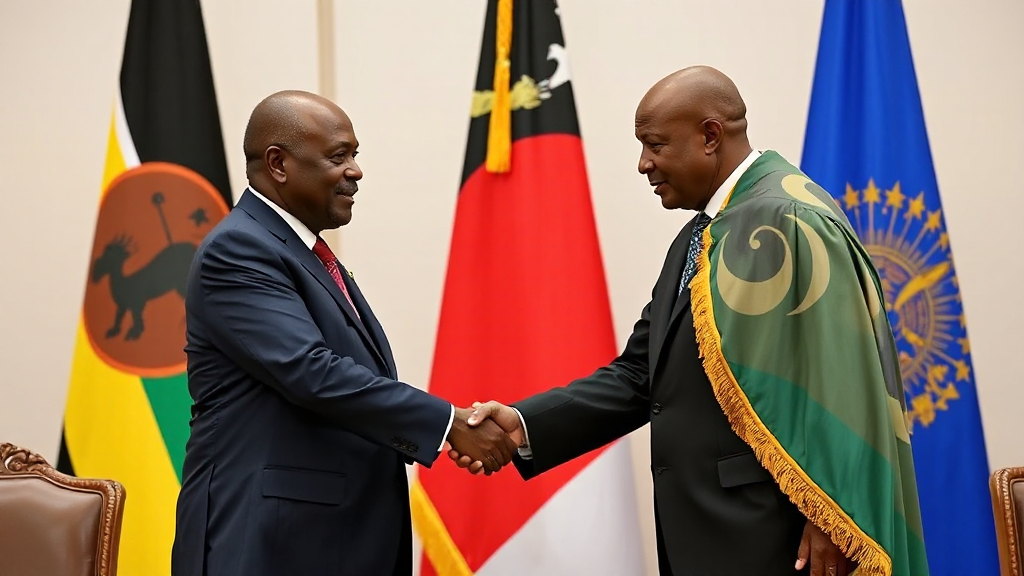
Presidents William Ruto and Samia Suluhu Hassan signed a landmark bilateral trade and cooperation agreement in Arusha on Friday, formally closing a chapter of commercial friction that had periodically soured relations between East Africa’s two largest economies. The Joint Nairobi-Dar es Salaam Economic Cooperation Framework, as the pact is formally titled, was witnessed by cabinet ministers from both countries and a delegation of business leaders drawn from the Kenya Private Sector Alliance and Tanzania’s Confederation of Tanzania Industries.
The signing ceremony, held at the Arusha International Conference Centre, comes two years after a diplomatic rupture triggered by Tanzania’s temporary ban on Kenyan poultry and dairy products, and the subsequent tit-for-tat restrictions on Tanzanian cement and sugar entering Kenya. Both restrictions have now been formally lifted under the new agreement.
Key Provisions of the Pact
The agreement’s most significant provision is the elimination of 23 identified non-tariff barriers that had impeded bilateral trade, which stood at Ksh 187 billion in the 2025 calendar year — well below the Ksh 280 billion that the East African Business Council estimated the corridor should be generating given the size of both economies.
Among the barriers removed are duplicative standards inspections at the Namanga and Isebania border crossings, which had added between two and five days to the transit time for perishable goods. Kenyan fresh produce exporters, particularly horticulture firms in the Mt Kenya region, have long complained that Tanzanian phytosanitary checks effectively functioned as a protectionist instrument rather than a legitimate regulatory tool.
A new Joint Border Economic Zone will be established at Namanga, straddling the two countries’ territory, with a combined investment incentive package including a 10-year corporate tax holiday, a single customs window, and co-located standards testing laboratories. The zone is expected to become operational by the first quarter of 2028 and has drawn early expressions of interest from manufacturers seeking to serve both the Kenyan and Tanzanian markets from a single location.
President Ruto described the signing as a decisive step towards the East African Community’s goal of a fully operational common market. “The distance between Nairobi and Dar es Salaam is three hours by flight. The distance between our two economies has been far longer than that, and today we begin to close it,” President Ruto said.
President Hassan, speaking in Swahili, said Tanzania had moved beyond any suspicion that deeper integration with Kenya meant economic subordination. “Ushirikiano si udhalilishaji — cooperation is not subjugation. It is the path to prosperity for all our people,” she said, drawing warm applause from the assembled delegates.
SGR and Infrastructure Links
The pact also includes a joint commitment to accelerate feasibility studies for the extension of Kenya’s Standard Gauge Railway from Naivasha to Kisumu and onward to the Tanzanian border at Sirare. The SGR, which has seen passenger numbers rise 34 per cent year-on-year in 2026, is viewed by both governments as the backbone of a future integrated transport corridor connecting Mombasa to Dar es Salaam via the interior.
A complementary road upgrade programme along the B8 highway between Namanga and Arusha will be jointly funded, with the African Development Bank already having signalled willingness to co-finance the Tanzanian section. Kenya’s National Construction Authority will provide technical oversight for the Kenyan segment, with works expected to begin in early 2027.
Business Reaction and EAC Context
The Kenya Association of Manufacturers welcomed the pact, with CEO Tobias Alando describing it as “the most commercially meaningful bilateral agreement Kenya has signed in a decade.” The East African Community Secretariat in Arusha also applauded the development, noting that persistent bilateral barriers between anchor economies had been the single greatest obstacle to the customs union’s functioning as designed.
Trade economists caution that implementation will be the real test. Previous agreements between the two countries — including a 2016 memorandum of understanding on border management — remained largely unimplemented due to bureaucratic inertia and vested interests among border officials accustomed to informal revenue streams at crossing points. Both governments have committed to a six-monthly joint review mechanism, chaired by their respective trade ministers, to monitor progress against agreed timelines.

0 comments