
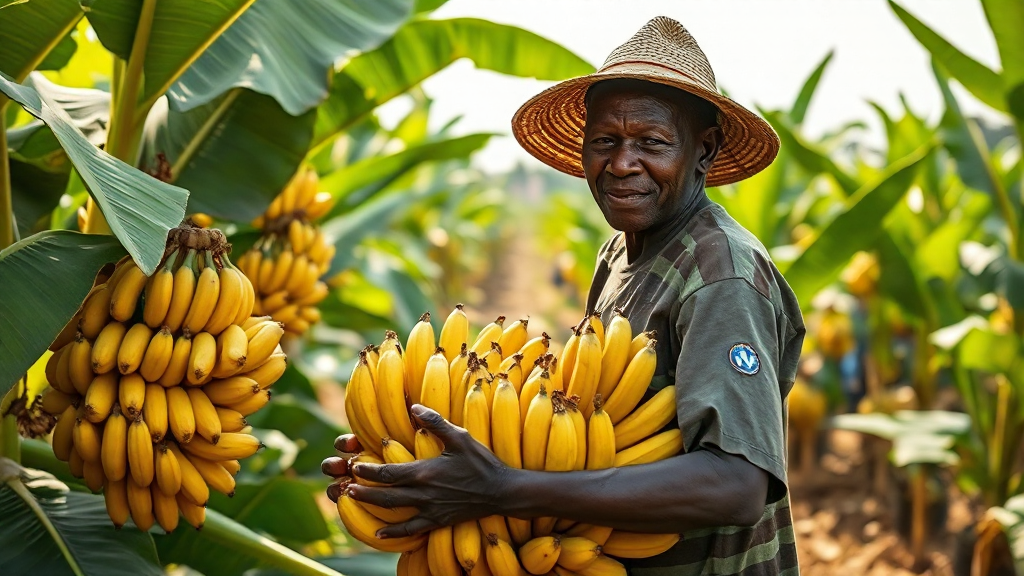
Kisii County has emerged as Kenya’s leading banana-producing county in the 2025/26 agricultural season, supplying an estimated 420,000 metric tonnes to domestic markets and displacing Murang’a — long considered the heartland of Kenya’s banana economy — from the top position it has held for more than three decades. The transformation, documented in a Horticultural Crops Directorate report released in Nairobi last month, is the product of a systematic hybrid variety rollout that began in 2022 and has reshaped the farming landscape of the South Nyanza highlands.
The Hybrid Variety That Changed Everything
The catalyst for Kisii’s rise is the Grand Nain tissue-culture banana variety, introduced through a partnership between the Kenya Plant Health Inspectorate Service (KEPHIS), KALRO, and private nurseries supported by a Dutch development finance facility. Unlike the traditional Mzigo and Ng’ombe varieties most Kisii farmers cultivated for generations — which take 14 to 18 months to first harvest and yield between 12 and 18 tonnes per hectare — Grand Nain matures in nine to eleven months, yields between 40 and 50 tonnes per hectare under good management, and produces a uniformly sized, disease-resistant bunch that the wholesale market strongly prefers. By June 2026, approximately 47,000 Kisii smallholder households had adopted the tissue-culture variety, each typically planting between 0.25 and one hectare.
“Kisii is a natural banana greenhouse,” said KALRO’s regional coordinator for western Kenya, Dr Beatrice Otieno. “We gave farmers the right planting material, some basic training on spacing and nutrition management, and nature did the rest.” The county’s unique attributes — year-round rainfall averaging 1,800 millimetres, deep volcanic soils, and a dense rural road network maintained by a proactive county government — created near-ideal conditions for the variety to express its genetic potential.
Economic Transformation on the Farm
The income shift for participating households has been substantial. Mary Kerubo, who farms 0.4 hectares in Nyamache Sub-county, says her banana income tripled in 2025. “I used to earn about Ksh 45,000 a year from bananas. Last year I earned Ksh 148,000. I have taken my children back to school and I am building a better house.” A survey by the County Department of Agriculture found that adopting households reported a median 180 per cent increase in banana-sourced income over two seasons. Kisii town’s wholesale fruit market has expanded significantly, drawing buyers from Nairobi, Eldoret, Kisumu, and increasingly Kampala and Dar es Salaam, reflecting the deepening East African Community trade integration that both Kenya and Uganda have prioritised. The additional commercial activity has created informal employment for hundreds of youth as loaders, sorters, and transporters.
Challenges of Success and the Road Ahead
The volume surge has exposed infrastructure bottlenecks. The road network serving the most productive banana zones in Nyamache, Bomachoge Chache, and Kitutu Masaba sub-counties deteriorates sharply in the rainy season, and farmers report losing between 5 and 12 per cent of their harvest to bruising and breakage during transit. Kisii Governor Simba Arati announced in March 2026 a Ksh 1.8 billion road rehabilitation programme targeting these agricultural corridors, with construction expected to begin before the end of the year. Quality consistency is also an emerging concern, as improper post-harvest handling reduces the wholesale price premium of Grand Nain. The county’s extension service has trained 312 community-level banana quality champions, but coverage across 45 wards remains uneven. Looking ahead, Kisii County is in preliminary discussions with a Kenyan exporter to trial shipments to the Gulf Cooperation Council market, where demand exists for flavourful East African highland banana varieties distinct from the global Cavendish. If successful, export diversification could cement Kisii’s new status as Kenya’s banana capital for years to come.

0 comments