
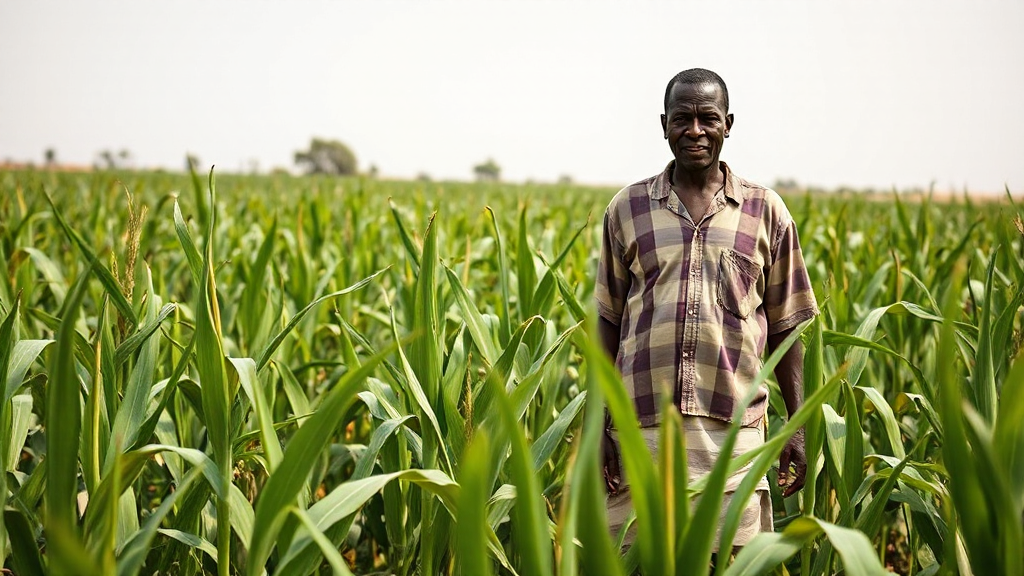
In Kitui County, where maize harvests have historically been the difference between food sufficiency and emergency aid, farmers who planted the DUMA 43 drought-tolerant variety this season are harvesting an average of 28 bags per acre — compared with the 17 bags that conventional open-pollinated varieties delivered under similar conditions two years ago. That 60 per cent yield improvement, replicated across a cluster of arid and semi-arid land (ASAL) counties including Makueni, Machakos, Kwale, Kilifi, and Tharaka-Nithi, represents one of the more tangible agricultural policy wins of President Ruto’s administration as it enters its third year.
The Science Behind the Seed
The DUMA series — an acronym drawn from the Swahili for “cheetah”, connoting speed and agility — is a product of more than a decade of collaborative breeding work between the Kenya Agricultural and Livestock Research Organisation (KALRO), the International Maize and Wheat Improvement Centre (CIMMYT), and seed companies including Kenya Seed Company and Pannar. The varieties are engineered to maintain productivity under a soil moisture deficit of up to 40 per cent below optimal, to mature in as few as 90 days in shorter rainfall windows, and to resist maize streak virus, a pathogen that commonly exploits plant stress in dry conditions.
KALRO Director General Dr Eliud Kireger described the 2025/26 season results as a validation of long-term public investment in adaptive research. “We have been working on these varieties since 2009. The climate crisis has not waited for us, but at least we now have tools that work in the field conditions our farmers actually face,” he said at a field day in Mwingi, Kitui County, in May 2026. The event attracted more than 800 farmers from four counties and was livestreamed on Safaricom’s platform, drawing tens of thousands of additional viewers across the country.
Scaling Up Distribution
A key factor in the 2025/26 season’s success was a revised seed subsidy logistics model implemented by the Agriculture Ministry following years of distribution failures that saw subsidised seed arrive after the planting window had closed. Working with agro-dealer networks and leveraging Safaricom’s M-Pesa for payment verification, the government pre-positioned DUMA series seed at 1,200 agro-dealer outlets across ASAL counties before the start of the short rains in October 2025. Farmers received electronic vouchers via SMS, redeemable at registered dealers, eliminating the queuing chaos that had plagued previous in-kind distribution schemes.
“Last year I got my seed in January when the rains were already finished,” said Mary Mutua, a smallholder farmer in Mbooni, Makueni County. “This year I had the seed in October, I planted on time, and I have enough maize to feed my family and sell the surplus.” Approximately 180,000 households accessed subsidised DUMA seed in the 2025/26 season, against a target of 150,000. The government has set a revised target of 250,000 households for the 2026/27 season, backed by a Ksh 2.1 billion allocation in the agriculture budget, an increase of 40 per cent over the previous year.
Remaining Challenges
Agronomists caution that seed alone is not sufficient to sustain yield gains beyond one or two seasons. Continuous cropping without adequate soil fertility management depletes the micronutrient base that DUMA varieties require to express their genetic potential. Affordable access to the correct fertiliser formulation remains limited in remote ASAL markets where agro-dealer penetration is thin. Water harvesting infrastructure — farm ponds, half-moon catchments, and zai pits — can significantly amplify the performance of drought-tolerant varieties by capturing whatever rainfall does arrive. Youth extension volunteers, mobilised through a programme inspired in part by the civic energy of the 2023 Gen Z protests, are filling some of the extension gap in counties like Tharaka-Nithi and Embu. The 60 per cent yield gain is real and significant — the question is whether it can be institutionalised into a permanent feature of ASAL farming or whether it will remain a promising season’s anomaly.

0 comments