
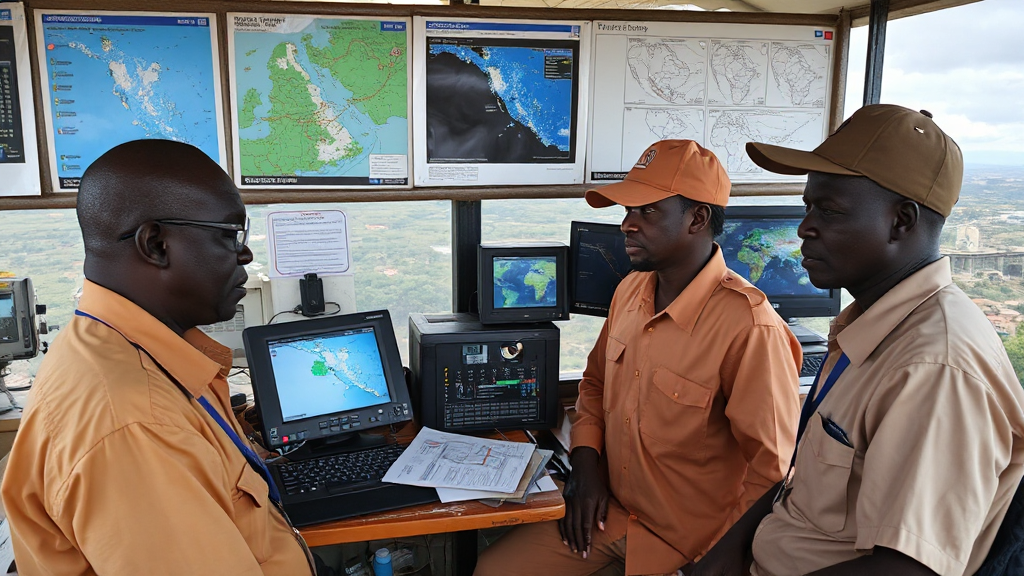
Kenya is deploying Ksh 9 billion across a multi-agency programme to fundamentally upgrade its flood early warning and disaster response infrastructure, two years after the 2024 El Nino weather event inflicted the worst flooding in the country’s recorded history, killing 215 people, displacing over 500,000, destroying 60,000 homes, and causing an estimated Ksh 85 billion in economic damage to roads, farms, and public facilities.
The 2024 long rains season, amplified by an unusually strong El Nino pattern, overwhelmed existing flood management systems with a speed and ferocity that exposed critical gaps in Kenya’s meteorological monitoring network, community alert systems, and government coordination protocols. The flooding of Mai Mahiu — where flash floods on 23 April 2024 swept through a gorge and claimed 70 lives in under three hours — became the defining image of a humanitarian failure that civil society and parliamentary committees subsequently investigated at length.
What the Investment Will Build
The Ksh 9 billion programme, managed jointly by the Kenya Meteorological Department, the Water Resources Authority, and the National Disaster Operations Centre, is structured around four principal investments. The first is an expanded river gauge network: an additional 280 automated water-level monitoring stations are being installed along high-risk river systems in the Nairobi, Tana, Athi, Kerio, and Ewaso Ng’iro basins. Each station transmits data in real time to the KMD’s flood monitoring platform, filling coverage gaps that meant forecasters in 2024 were operating without upstream data at critical catchment points.
The second investment is in weather radar. Kenya currently operates only three functional Doppler weather radars, leaving significant portions of the country — including much of the Rift Valley and the Coast hinterland — outside reliable short-range precipitation observation coverage. Four new radar installations, procured from a Finnish supplier under a development finance arrangement, will be commissioned by December 2026, substantially improving the KMD’s ability to detect intense convective precipitation cells that produce flash flooding with little warning.
The third component is digital community alert infrastructure. A nationwide Integrated Public Alert and Warning System is being built on a hybrid architecture combining automated SMS alerts triggered by sensor thresholds, siren networks in 200 high-risk urban flood zones, and a publicly accessible mobile application that delivers location-specific warnings and evacuation guidance. The system is designed to deliver community-level warnings at least six hours before projected flooding at identified hotspots — compared with the 90-minute average warning time available in 2024.
“Ninety minutes is not enough for a mother in Mathare to pack her family’s documents, collect her children from school, and reach higher ground,” said Meteorological Department Director Dr David Gikungu. “Six hours is survivable. Six hours is what we are building towards.”
Lessons From 2024
The post-disaster review commissioned by the National Disaster Management Unit identified several systemic failures beyond the technical. Warnings that were issued in 2024 were frequently not translated from technical meteorological language into actionable community guidance. Information reached national and county government officials but failed to cascade to ward administrators and village elders in time to prompt evacuation. Radio broadcasting — still the most reliable mass communication channel in rural Kenya — was not systematically used to amplify alerts.
The new system addresses this through a mandatory cascading alert protocol. When the KMD issues a flood watch for any sub-county, a standardised voice alert in Swahili and the dominant local language is automatically transmitted to community radio stations, ward offices, and local religious leaders registered as community alert coordinators. The Ministry of Interior has worked with chiefs and village elders to pre-identify and publicise evacuation routes and assembly points in all 290 constituencies identified as flood-prone.
The Mai Mahiu gorge specifically has received a bespoke monitoring and alert installation: four upstream water-level sensors now feed into an alarm system that triggers sirens in settlements below the gorge when upstream flow rates exceed defined thresholds. The system was tested during the March 2026 short rains and successfully issued an alert 4.5 hours before peak flow, during which county government trucks evacuated 340 households from the gorge’s floodplain without a single casualty.
Climate Finance and the Larger Challenge
Kenya’s experience with El Nino is part of a broader continental pattern that climate scientists consistently link to the warming of Indian Ocean surface temperatures driven by global greenhouse gas emissions — a process in which Kenya contributes minimally but suffers disproportionately. The Ruto administration has been vocal in international climate forums about the principle of loss and damage finance, and Kenya was an early signatory to the Santiago Network on loss and damage established under the UNFCCC.
The Ksh 9 billion early warning programme is partly funded through the Green Climate Fund and an African Development Bank climate resilience facility, with Kenya contributing approximately 40 per cent from its own budget — a commitment made under significant fiscal pressure given the country’s ongoing IMF programme and constrained public finances. Climate analysts note that even comprehensive early warning systems are ultimately an adaptation measure that manages the consequences of extreme weather rather than addressing its root causes — a distinction that Kenya’s negotiators make forcefully, and repeatedly, in every international climate conference they attend.

0 comments