
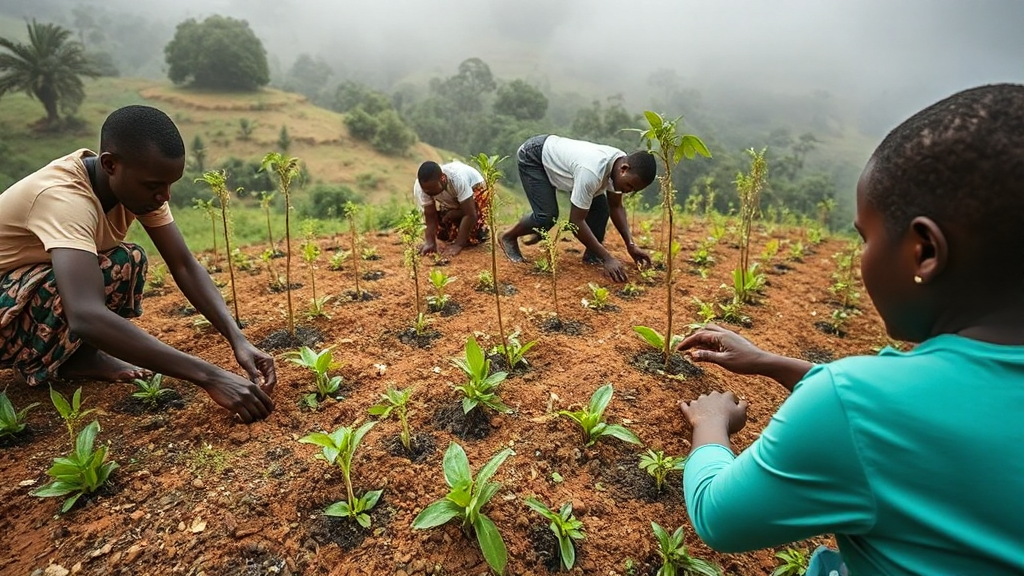
The Mau Forest Complex, East Africa’s largest montane forest and the source of 12 major rivers supplying water to approximately 40 per cent of Kenya’s population, has recorded a net gain of 50,000 hectares of tree cover over the three-year period ending December 2025, according to aerial survey data published by the Kenya Forest Service and independently verified by scientists at the University of Nairobi’s Wangari Maathai Institute.
The result marks the first sustained period of documented positive forest cover change in the Mau since reliable satellite monitoring began in the early 2000s, reversing decades of encroachment, illegal logging, and politically sanctioned excisions that reduced the complex from an estimated 416,000 hectares at independence to a low of approximately 273,000 hectares by 2010. The gains bring total forest cover in the Mau to around 380,000 hectares — still significantly below its historical extent but a trajectory shift that conservationists are describing as genuinely significant.
What Has Changed Since Previous Efforts
Earlier reforestation attempts at the Mau — most notably the efforts associated with the late Nobel laureate Wangari Maathai’s Green Belt Movement and the Kibaki-era Mau Task Force chaired by Raila Odinga in 2009 — achieved partial success but were repeatedly undermined by political interference, inadequate resettlement of encroachers, and insufficient funding for sustained monitoring and replanting.
The current programme, operating under a mandate embedded in the 2022 Forest Conservation and Management Act and funded through a combination of the national government budget, a Green Climate Fund grant of USD 48 million, and carbon credit revenues, has several structural differences. Community Forest Associations now hold legally binding co-management agreements over their adjacent forest sections, giving local populations a direct economic stake in preventing encroachment rather than incentives to participate in it. CFA members receive a share of carbon revenue and priority employment in reforestation activities.
“The model that failed before was government planting trees and communities cutting them down,” said Kenya Forest Service Director General Alexander Lemarkoko. “The model that is working is communities being the owners of the trees. You do not cut down your own asset.”
Drone-assisted monitoring, deployed since 2023 across the most critical zones of the Mau, has dramatically reduced the response time to detected encroachment. Rangers equipped with real-time drone footage and GPS-linked incident reporting can reach an encroachment event within hours rather than days, and the documentation generated is admissible in the Environment and Land Court circuit that now holds sittings in Nakuru specifically to handle Mau-related cases.
Downstream Water Implications
The hydrological implications of the Mau’s recovery are beginning to appear in river gauge data. The Water Resources Authority has recorded increased dry-season base flows in the Ewaso Ng’iro South, Sondu, and Njoro rivers compared with five-year averages — a cautious but measurable indicator that restored catchment vegetation is improving water retention. Communities downstream in Narok County, which hosts the Maasai Mara ecosystem, have reported improved seasonal stream flows that support livestock watering during the critical January-to-March dry period.
The Mau also drains into Lake Nakuru and Lake Elementaita, both Ramsar-listed flamingo habitats whose ecological health is directly linked to upstream forest integrity. Kenya Wildlife Service ecologists monitoring flamingo populations at Lake Nakuru report improved water quality indicators in the 2025 wet season compared with 2022, though they caution that multiple variables affect flamingo numbers and attributing ecosystem changes solely to forest recovery requires longer data series.
The Work That Remains
Fifty thousand hectares is a significant milestone, but the gap between current cover and the Mau’s historical extent remains substantial. The Kenya Forest Service estimates that full ecological restoration — bringing the complex to functional forest conditions across its entire gazetted area — will require at least another decade of sustained planting, with annual replanting targets of 12,000 to 15,000 hectares.
The political dimension is ever-present. Rift Valley communities that were resettled out of excised Mau areas during previous administration programmes harbour ongoing grievances, and some displaced families have returned to forest-adjacent land, creating a persistent source of boundary pressure. Environment Cabinet Secretary Aden Duale has committed to completing a transparent land audit of all Mau excisions made between 2001 and 2011, with the aim of separating legitimate smallholder claims from politically connected large-scale encroachments. That process, long delayed, has begun but is expected to take at least two more years to conclude — a reminder that even the most encouraging ecological recovery stories in Kenya unfold against a backdrop of unresolved political complexity.

0 comments