
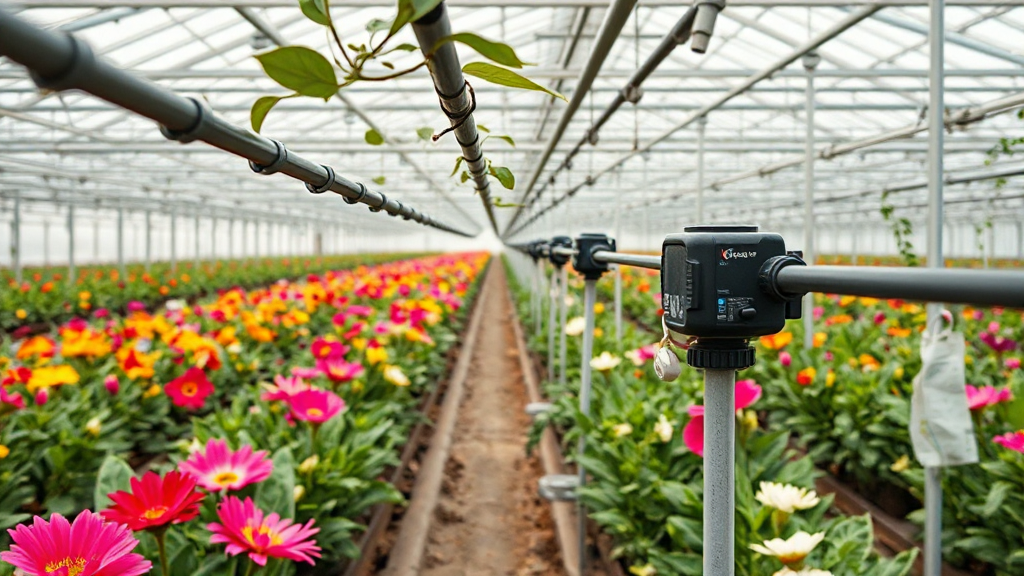
Kenyan flower farms clustered around Lake Naivasha, the country’s horticultural heartland, have achieved an average 40 per cent reduction in irrigation water consumption following the adoption of sensor-based smart irrigation systems, according to data published this month by the Kenya Flower Council. The savings, measured across 34 large-scale farms covering approximately 6,200 hectares during the 2025/26 growing season, represent one of the most significant efficiency improvements in the sector since the introduction of hydroponic cultivation in the 1990s.
Kenya is the world’s third-largest cut flower exporter, with annual export revenues of approximately Ksh 145 billion. The industry employs over 150,000 people directly and supports an estimated 500,000 livelihoods. The vast majority of production is concentrated around Lake Naivasha in Nakuru County, where the lake itself supplies irrigation water and the high-altitude climate produces the long-stemmed roses that European and Asian markets prize.
What Smart Irrigation Involves
Traditional irrigation scheduling on Kenyan flower farms relied on agronomist judgement, fixed timer systems, and broad evapotranspiration estimates. The smart systems adopted by the farms in the study replace this approach with a network of soil moisture sensors placed at multiple depths in each greenhouse bed, microclimate weather stations measuring temperature, humidity, and solar radiation, and a centralised control platform that integrates all inputs to calculate precise irrigation scheduling in intervals as short as 15 minutes.
Several farms have extended the system with machine-learning layers that account for flower variety, growth stage, and historical water-use data to generate predictive irrigation schedules that anticipate plant demand rather than reacting to moisture deficits after they occur. Sian Farms, one of the largest operations in the Naivasha basin, reports that its AI-integrated system has reduced irrigation events by 60 per cent while maintaining or improving stem quality scores — a finding that has attracted attention from agronomists who long assumed that more frequent watering improved flower grade.
“We were irrigating partly out of habit and partly out of caution,” said Sian Farms Head of Agronomy Patrick Mwangi. “The sensor data showed us that we were watering soil that was already at optimal moisture. The system tells us when the plant actually needs water, not when the clock tells us to give it.”
The Lake Naivasha Dimension
The environmental stakes around water use in the Naivasha basin are significant and well-documented. Lake Naivasha’s water level has fluctuated dramatically over the past three decades, with intensive extraction for floriculture identified by WWF and the Lake Naivasha Riparian Association as a major contributing factor alongside climate variability. The lake supports a Ramsar-listed wetland ecosystem, wildlife populations including hippos and over 400 bird species, and the livelihoods of fishing communities dependent on healthy water levels.
The National Environment Management Authority has progressively tightened water abstraction permits for Naivasha basin farms since 2020, and the Water Resources Authority imposed a 15 per cent mandatory reduction in licensed abstraction volumes in 2024 as part of Kenya’s El Nino adaptation response. For farms facing declining permit volumes, smart irrigation is not purely a cost-saving measure — it is the mechanism through which they can maintain production without breaching regulatory limits.
“The farms that cannot get their water efficiency up will face permit curtailment. That is the regulatory reality,” said Water Resources Authority CEO Mwenda Njoka. “What is encouraging is that the majority are moving proactively rather than waiting for enforcement.”
Cost and Access
A full smart irrigation installation for a medium-scale greenhouse block of five hectares costs approximately Ksh 2.8 million, with a payback period estimated at 2.5 to 3.5 years based on reduced water pump energy costs and lower water permit fees. The Kenya Flower Council has negotiated a preferential financing facility with Equity Bank allowing member farms to access the capital at 10.5 per cent over five years.
The technology’s adoption is not uniform. Small-scale growers producing for the local market typically cannot access the capital or technical support required for full smart systems, though lower-cost soil moisture sensor kits retailing at around Ksh 45,000 per greenhouse unit are increasingly available through agricultural input distributors in Naivasha town. The Kenya Agricultural and Livestock Research Organisation is running demonstration plots at its Naivasha station to extend practical knowledge of the technology to small growers who have not had access to commercial agronomic support — ensuring that the efficiency gains of Kenya’s floriculture sector do not accrue only to those who can already afford the best technology.

0 comments