
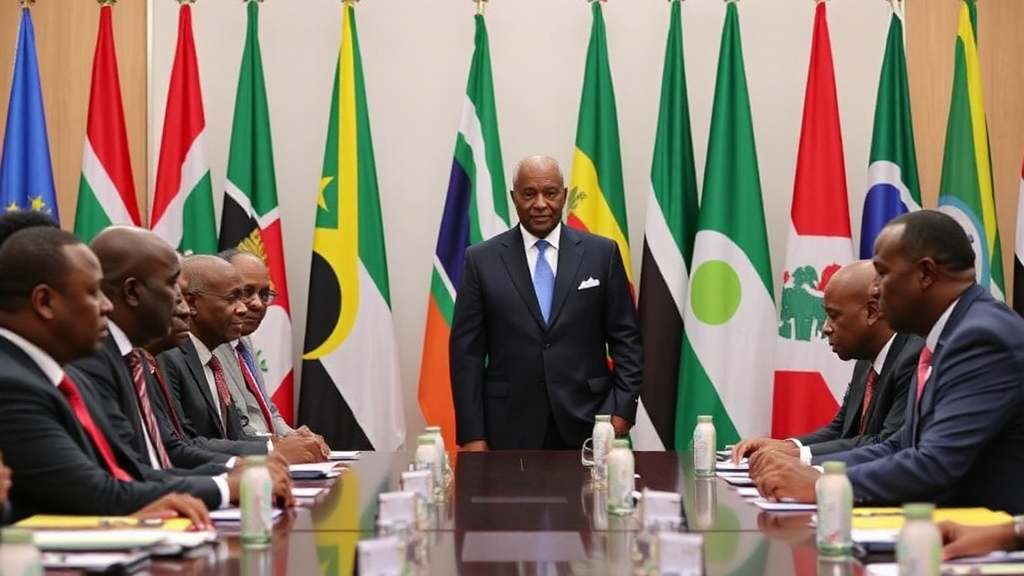
The heads of state of the East African Community’s seven member states gathered in Arusha, Tanzania last weekend for a summit that produced what EAC Secretary-General Peter Mathuki called “the most consequential single document in the bloc’s 25-year history” — a detailed, time-bound roadmap toward the introduction of a single East African currency, targeting full monetary union by 2031. Kenya’s President Ruto, in his capacity as the current EAC chair, presided over the signing ceremony and was designated to chair the new EAC Monetary Integration Technical Transition Committee, positioning Nairobi at the centre of what will be a five-year process of extraordinary economic and institutional complexity.
The roadmap, formally titled the Arusha Monetary Integration Framework, commits all seven member states — Kenya, Tanzania, Uganda, Rwanda, Burundi, South Sudan, and the Democratic Republic of Congo, which joined the EAC in 2022 — to a phased convergence programme with defined milestones. The first phase, running through 2027, focuses on the harmonisation of fiscal policies, with member states required to achieve budget deficit targets of no more than 3 per cent of GDP and inflation rates converging toward a corridor of 5 to 8 per cent. The second phase, 2028 to 2030, involves the establishment of an East African Central Bank and the design of a common currency instrument. The third phase, targeting completion by December 2031, involves the withdrawal of national currencies and the introduction of the East African Shilling — a name agreed at the summit over the previously proposed “Shilingi ya Afrika Mashariki.”
Kenya’s Central Role
Kenya’s designation as leader of the transition committee reflects both its economic weight within the bloc — the Kenyan economy accounts for approximately 35 per cent of EAC GDP — and the Ruto administration’s consistent advocacy for deeper regional integration. Nairobi will host the transition committee’s permanent secretariat, which will be staffed by economists seconded from member state central banks and financed through a special integration fund to which each member state will contribute proportionally.
Central Bank of Kenya Governor Kamau Thugge, who led Kenya’s technical negotiating team at the Arusha summit, acknowledged the ambition of the timeline. “We are not pretending this is simple,” he told reporters after the signing. “Monetary union requires sustained political will across seven governments with very different fiscal positions. But the roadmap is designed to be honest about that difficulty, with trigger mechanisms that allow phases to be extended without the entire framework collapsing.”
The framework includes a fiscal convergence monitoring mechanism, administered jointly by the EAC Secretariat and the African Development Bank, that will publish quarterly assessments of each member state’s progress against convergence targets. Member states that fall materially behind their targets will enter a consultation process with their peers before any punitive measures — described in the framework as “corrective engagement protocols” — are applied.
Sceptics and Structural Challenges
Not all economists share the summit’s optimism. Among the most frequently cited concerns is the extraordinary heterogeneity of the seven member states, whose GDP per capita ranges from approximately $260 in Burundi to over $2,100 in Kenya. Integrating monetary policy across economies at such different stages of development — and with such different fiscal institutional capacities — will require transfers and adjustment mechanisms that the current framework, critics argue, does not adequately fund.
Former Treasury PS Kamau Maigua, speaking to ZaKenya.com, noted that the eurozone’s experience provided both inspiration and warning. “The single currency dream is real and achievable,” he said. “But Europe took 50 years and still nearly fell apart in 2011. We are attempting something comparable in a decade. The targets are political statements as much as economic plans.”
What It Means for Kenya
For ordinary Kenyans, the immediate implications are modest — the single currency remains five years away even under the most optimistic scenario. But the medium-term stakes are significant. A functioning monetary union would eliminate exchange rate costs and risks for businesses trading within the EAC, deepen capital markets, and potentially enhance the bloc’s collective negotiating power in global trade and investment attraction. For Kenya specifically, whose Safaricom M-Pesa platform already processes cross-border transactions across several EAC countries, the integration of monetary systems represents both an opportunity and a responsibility. The Kenyan shilling’s relative stability compared to several partner currencies will be an asset in the convergence process — provided Kenya maintains the fiscal discipline its IMF programme currently enforces.

0 comments