
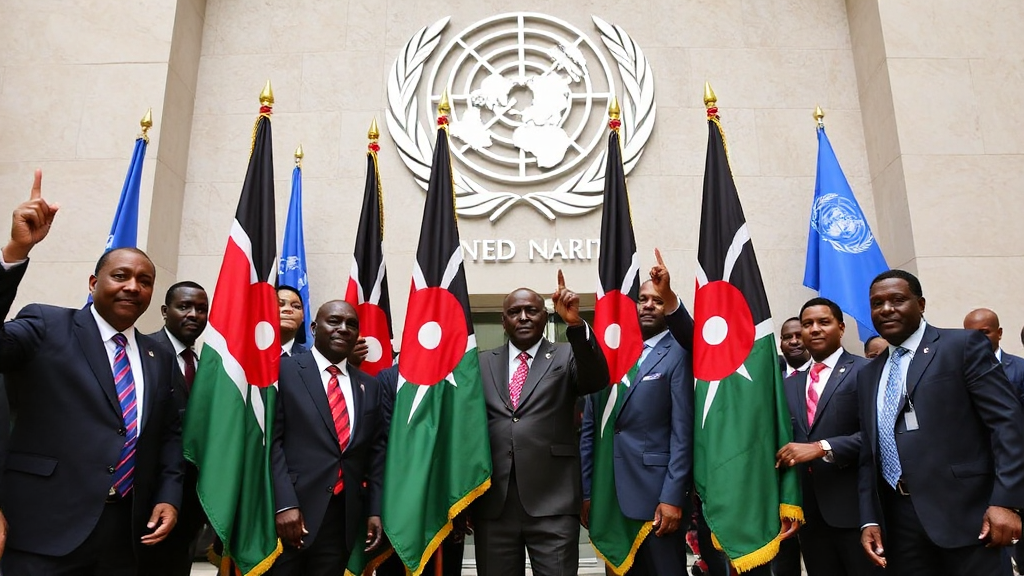
Kenya’s flag was raised in celebration outside the Ministry of Foreign Affairs on Harambee Avenue on Thursday evening after the United Nations General Assembly in New York elected Nairobi to a non-permanent seat on the UN Security Council for the 2027-2028 term, securing the Africa Group’s allocated seat with 181 votes out of 193 — the highest vote share recorded by any African candidate in the election’s modern history. Foreign Affairs Cabinet Secretary Musalia Mudavadi, present at UN headquarters in New York for the vote, described the result as “a ringing affirmation of Kenya’s place in the world.”
The election, held on the first Thursday of July during the General Assembly’s regular session, saw Kenya run unopposed for the seat following the Africa Group’s decision in May to endorse Nairobi as the continent’s consensus candidate, ending a brief competition with Ghana that had been resolved through diplomatic consultations in Addis Ababa. The 181-vote tally nonetheless reflects remarkable breadth of international support, including from countries across the Global South with whom Kenya has invested in relationship-building under the Ruto administration’s Nairobi Consensus foreign policy framework.
A Campaign Years in the Making
Kenya last held a Security Council seat in 1997-1998. The campaign to return to the Council was formally launched by the Kenyatta administration in 2021 and carried forward and substantially intensified by President Ruto after his election in 2022. The effort involved a methodical programme of bilateral diplomacy — Kenya’s foreign missions filed more than 200 individual lobbying reports in 2025 alone — alongside multilateral positioning through the African Union, the Commonwealth, and the Global South platforms Ruto has championed.
Key to the campaign was Kenya’s credibility as a contributor to international peace and security. The country’s decade-long AMISOM and ATMIS presence in Somalia, its current leadership of the Haiti MSS Mission, its mediation role in the DRC’s Nairobi Process, and its diplomatic engagement on the Sudan crisis were all explicitly cited in advocacy materials as evidence that Kenya was not merely seeking a platform but bringing operational capacity and diplomatic gravitas to the Council’s work.
“Every vote we secured came from a relationship we built over years,” said Principal Secretary for Foreign Affairs Macharia Kamau. “This is not a lucky outcome. It is the return on a deliberate investment.”
What the Seat Means
Non-permanent members of the Security Council hold genuine, if circumscribed, power. They participate in all Council deliberations and negotiations, vote on resolutions including those authorising peacekeeping operations and imposing sanctions, and can shape Council agendas during their presidency months. Kenya is expected to hold the Council presidency — the rotating monthly chairmanship — twice during its two-year term, providing opportunities to convene high-level meetings on issues of Kenya’s choosing.
CS Mudavadi outlined three priority themes that Kenya intends to champion from the Council seat: sustainable peace financing — the idea that peace operations must be integrated with development programming to be durable; climate-security nexus issues, particularly the role of resource competition in driving conflict on the African continent; and reform of the Security Council itself, including the longstanding demand for permanent African representation on a body whose current structure was designed in 1945.
Domestic Reception
In Nairobi, the reaction was one of broad national pride that cut across political lines. Even opposition figures who have been sharply critical of President Ruto’s domestic governance offered congratulations on the diplomatic achievement. The win arrives at a moment when Ruto’s domestic approval ratings, shaped by austerity measures linked to the IMF programme and the legacy of the 2024 protests, are under pressure — and the Council seat provides a genuine point of unifying national achievement. “This is not Ruto’s victory or Jubilee’s victory or Azimio’s victory,” said Nairobi political commentator Jaindi Kisero. “This is Kenya’s victory, and we should own it as such.”

0 comments