
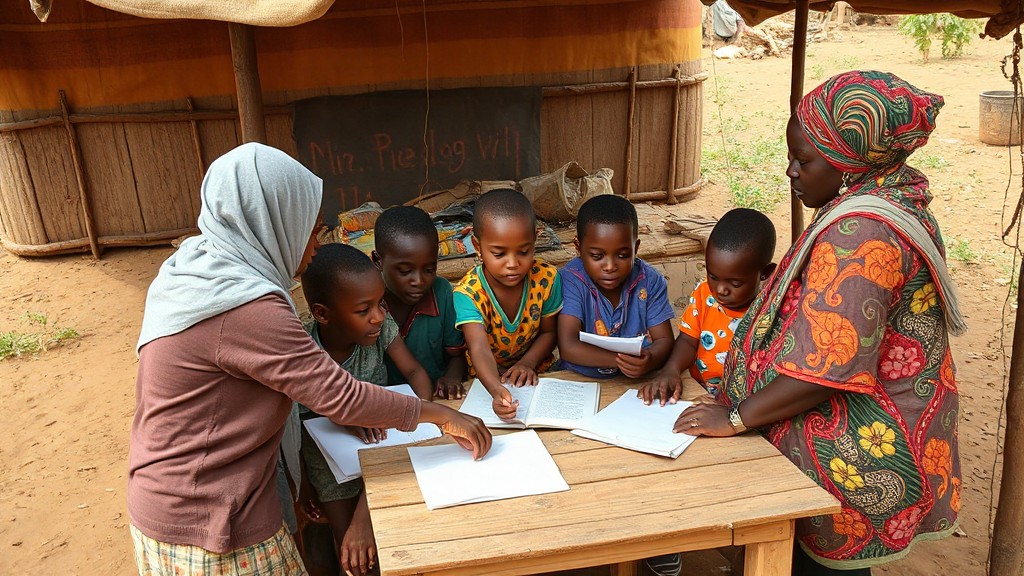
Literacy rates among children in Kenya’s pastoralist communities have reached 74 per cent, according to data published by the Kenya National Bureau of Statistics (KNBS) in its 2026 Arid and Semi-Arid Lands Education Survey — a figure that represents a remarkable 31 percentage-point improvement from the 43 per cent rate recorded in the same survey in 2015. Officials and researchers credit the gain primarily to the Mobile School Programme, a nomadic-education initiative that has over the past decade dispatched collapsible classrooms, trained mobile teachers, and digitally equipped learning hubs to follow pastoralist communities across Kenya’s northern and north-eastern counties.
The programme operates in Turkana, Marsabit, Samburu, Isiolo, Garissa, Wajir, Mandera, and Tana River counties — a combined area of approximately 500,000 square kilometres representing roughly 90 per cent of Kenya’s ASAL geography. In communities where cattle, camel, and goat herds must move seasonally in search of pasture and water — patterns further disrupted by El Niño flooding in 2023 and drought cycles in 2024 — fixed-location schools have historically been irrelevant to families who cannot leave their children behind while the community moves.
How the Mobile Schools Work
The Mobile School Programme deploys 620 mobile learning units — a combination of purpose-built tented classrooms and retrofitted solar-powered buses — that move on a pre-mapped schedule tracking the seasonal migration routes of the twelve largest pastoralist communities. Each unit serves between 80 and 150 learners and is staffed by two teachers trained in multilingual instruction, covering Swahili, English, and the relevant community language (Turkana, Borana, Samburu, or Somali) as the medium of instruction in lower classes.
A lesson typically lasts 90 minutes, delivered in the morning before the heat peaks and community activities dominate. The KICD has developed a condensed curriculum — known internally as the Nomadic Learning Framework — that covers the CBC competencies in a sequence calibrated for irregular attendance, so that a child who misses two weeks because the community has moved outside the mobile unit’s schedule does not fall hopelessly behind when the unit returns.
“My mother never went to school because the school was not where we were. Now the school is where we are,” said Naomi Lochom, 13, a Turkana learner from a community along the Kerio River whose unit visited every three weeks. Naomi reads fluently in Turkana and Swahili and is studying numeracy at what her teacher assessed as a Grade Five level — well above the average for her age cohort three years ago.
Technology as an Enabler
The programme’s recent acceleration owes much to technology investments that have made mobile delivery more effective and less dependent on teacher availability. Each mobile unit carries a set of forty solar-charged tablets preloaded with offline CBC content, enabling self-directed learning on days when the unit is between communities or when the single teacher is occupied with assessment tasks. Safaricom’s Loon-successor satellite connectivity pilot, operating in northern Turkana since late 2024, has given fourteen of the most remote mobile units reliable internet access for the first time, enabling video lessons from Nairobi-based teachers and real-time attendance data submission to the Ministry.
The KNBS survey also credits a complementary initiative: the Mother Tongue Literacy Campaign, run jointly by the Ministry and UNESCO, which has trained 1,800 community members — primarily women — as paraprofessional literacy facilitators who conduct evening sessions for adults and parents in parallel with the mobile school’s work with children. Adult literacy in pastoralist communities, measured at 51 per cent in the 2026 survey compared to 31 per cent in 2015, has risen significantly as a direct result of this parallel stream.
Challenges That Remain
A 74 per cent literacy rate, while historically exceptional for these communities, still trails the national average of 86 per cent and leaves roughly one in four pastoralist children outside the reach of functional literacy. Climate disruption — El Niño-driven flooding destroyed three mobile school units in Turkana West in November 2023, and extreme heat events have forced the cancellation of learning sessions with increasing frequency — remains the programme’s most unpredictable operational threat.
Transition to higher education remains the other outstanding challenge. Mobile school learners who complete Grade Six face a structural cliff: Kenya’s junior and senior schools are fixed-location institutions that require settlement, a condition many pastoralist families cannot or will not adopt. The Ministry of Education is piloting boarding junior schools in Lodwar, Marsabit town, and Garissa that are specifically designed for pastoralist learners, with school calendars adjusted to align with seasonal migration patterns so that students can return to their communities during peak movement months without losing academic continuity.
“Seventy-four per cent is not the destination — it is proof of direction,” said Education CS Julius Ogamba, who visited a mobile unit in Samburu County in April 2026. “The destination is a Kenya where a child born in a manyatta in Turkana has the same shot at their dreams as a child born in Karen. We are not there yet. But we are closer than we have ever been.”

0 comments