
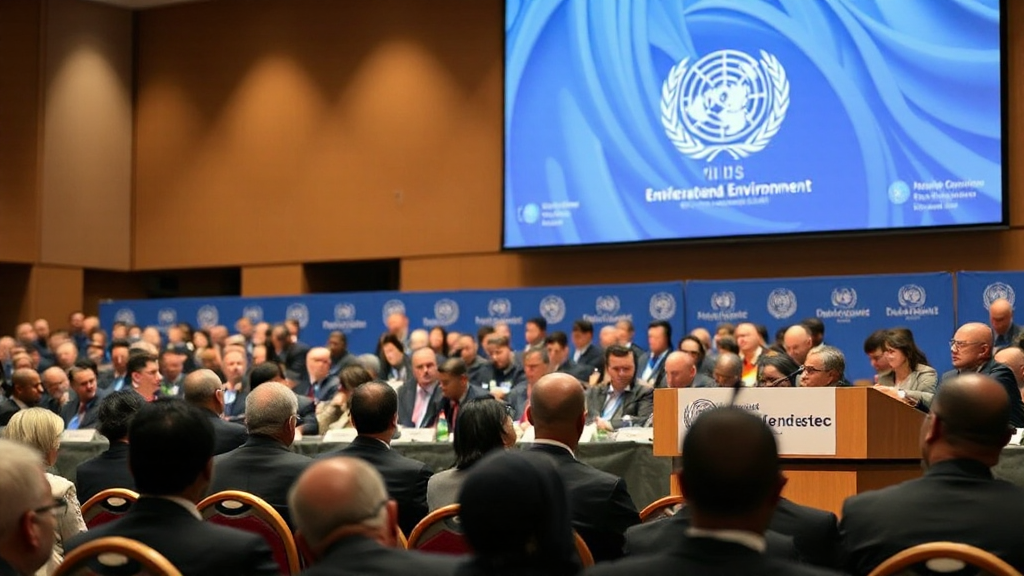
The United Nations Environment Programme’s Gigiri campus in Nairobi formally inaugurated its Global Plastic Waste Treaty Implementation Hub on 25 June 2026, a specialist unit charged with supporting the 175 signatory nations of the landmark Busan Plastics Treaty as they translate international commitments into domestic law, industry regulation, and waste-management infrastructure.
The hub, housed in a newly refurbished wing of the UNEP complex, brings together 48 technical staff drawn from environmental law, polymer chemistry, waste economics, and development finance. It will serve as the operational nerve centre for treaty monitoring, capacity-building, and dispute resolution — a role that cements Nairobi’s position as the administrative capital of global environmental governance alongside Geneva and New York.
Kenya’s Strategic Position
The decision to site the hub in Nairobi rather than Geneva or Bonn was itself a diplomatic achievement for Kenya’s Ministry of Foreign Affairs, which lobbied aggressively through the EAC bloc and the Africa Group of Negotiators during the final Busan conference sessions in late 2024. Cabinet Secretary Alfred Mutua, who attended the inauguration alongside Environment CS Soipan Tuya, described the outcome as “proof that Africa is no longer a venue for delivering decisions taken elsewhere — we are now where the decisions are made.”
UNEP Executive Director Inger Andersen, speaking via video link from Geneva, credited Kenya’s domestic environmental record — particularly its 2017 single-use plastics ban and subsequent enforcement — as a factor in the selection. “Nations look to Kenya and ask: how did you do it? That practical credibility matters enormously when we are trying to persuade governments that plastics transition is achievable,” she said.
For the local economy, the hub brings an estimated Sh2.8 billion annually in direct expenditure, including salaries, contractor fees, and procurement, according to a Nairobi City County economic assessment. A further multiplier effect is expected in hospitality, transportation, and professional services as the hub draws delegations from signatory nations throughout the year.
What the Hub Will Do
The Implementation Hub has three primary functions. First, it will maintain the treaty’s National Action Plan registry, reviewing and scoring the plans submitted by all 175 signatories against agreed benchmarks on production caps, extended producer responsibility schemes, and recycling-rate targets. Second, it will operate a technical assistance fund — currently capitalised at USD 340 million from contributions by the EU, Japan, and Canada — to help lower-income countries build collection and sorting infrastructure. Third, it will coordinate the treaty’s scientific panel, a body of 60 independent researchers who will report annually on the global plastic mass balance.
“Africa generates 17 per cent of the world’s plastic waste but processes less than four per cent of its own recycling,” said Dr Jacqueline Kimani, the Kenyan scientist appointed as the hub’s inaugural Director. “Our first priority is ensuring the technical assistance fund flows to where the infrastructure gap is widest — and that means sub-Saharan Africa must not be treated as an afterthought.”
Domestic Implications for Kenya
Kenya’s hosting role brings both prestige and scrutiny. Environmental auditors from the hub will be among the first to review Kenya’s own National Action Plan, due for submission by December 2026. Domestic critics have noted persistent challenges: plastic litter remains acute along the coast and in Nairobi’s informal settlements, a deposit-return scheme piloted in Kisumu and Mombasa in 2025 has seen only partial uptake, and plastic recycling capacity nationally stands at roughly 18 per cent of collected waste volumes.
The National Environment Management Authority (NEMA) Director-General Mamo Boru Mamo acknowledged the gaps but framed them as solvable. “Hosting the hub gives us access to technical assistance and financing that Kenya can use to close those gaps faster. We will not exempt ourselves from scrutiny — we will use the scrutiny as an engine,” he told journalists at the Gigiri event.
The inauguration coincided with a broader moment of momentum for Kenya’s environmental diplomacy: the country currently chairs the UNEA Bureau, holds a seat on the Loss and Damage Fund board established after COP28, and has submitted a bid to host the Africa Climate Summit’s permanent secretariat. For President Ruto, who has made climate leadership a signature foreign-policy theme since his speech at COP27, the Plastic Hub opening offers a tangible milestone ahead of what promises to be an intense 2027 electoral season.

0 comments