
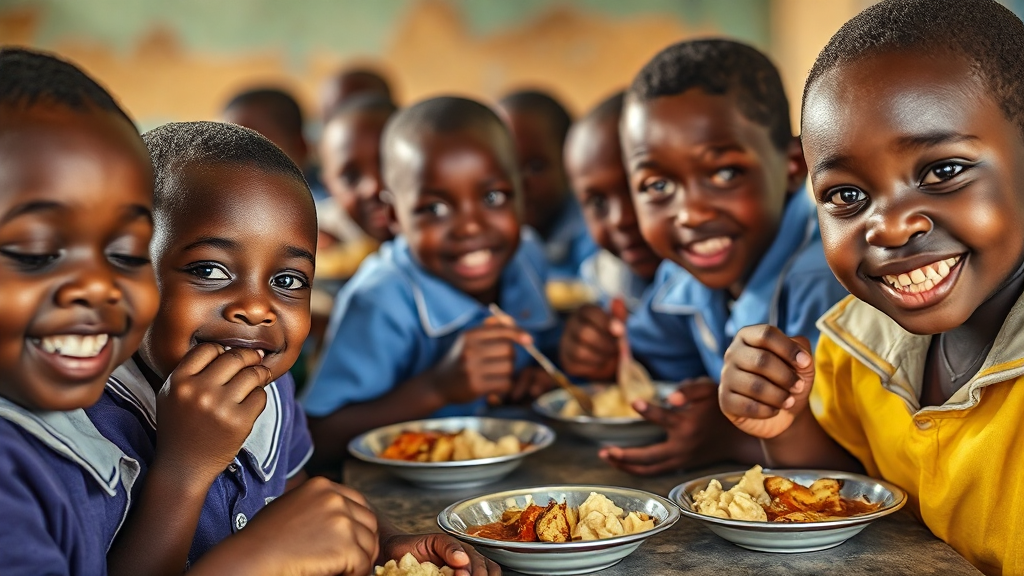
Kenya’s National School Meals Programme has received its largest expansion since its inception, with the government committing to feed four million primary school pupils across 47 counties by the end of December 2026 — a scale-up that education officials say will directly address stubbornly high absenteeism rates in food-insecure regions and help consolidate enrolment gains made over the past decade.
The expanded programme, announced jointly by the Ministry of Education and the State Department for Agriculture in Nairobi last month, comes with a revised Ksh 18.7 billion budget for the 2026/2027 financial year, representing a 34 per cent increase over the previous allocation. Crucially, at least 65 per cent of the food commodities — including maize, beans, vegetable oil, and fresh produce — will be sourced directly from smallholder farmers registered with the Kenya National Farmers’ Federation, replacing a model that relied heavily on imported or centrally procured staples.
From Imported to Home-Grown
The shift to local sourcing is the programme’s most significant structural change and reflects both a practical response to currency volatility — the shilling’s weakness made imported commodities increasingly expensive — and a deliberate policy choice to create market linkages for Kenya’s 3.6 million smallholder farming households.
“Every meal served in a Kenyan school should be grown by a Kenyan farmer,” said Agriculture CS Mutahi Kagwe at the launch event held at Kiambogo Primary School in Nyeri County. “This is not charity to children. It is a supply contract to farmers, a nutrition investment in students, and a school enrolment driver all at once.”
The World Food Programme (WFP), which has partnered with the Kenyan government on school meals since 2009, praised the home-grown model. WFP Kenya Representative Honora Blake said the agency had committed technical support for the procurement and logistics system over a three-year period. “The evidence from similar programmes in Ghana and Senegal shows that home-grown school feeding raises local farm incomes by between 20 and 30 per cent in the first two years,” Blake told reporters. “Kenya is now building one of the most ambitious versions of this model on the continent.”
Impact on Attendance and Learning
Independent evaluations of earlier phases of Kenya’s school feeding programme have consistently demonstrated its impact on attendance. A 2025 study by the African Population and Health Research Centre found that schools in the programme’s coverage zone recorded 22 per cent lower chronic absenteeism than comparable schools outside it, with the gap most pronounced among girls in arid and semi-arid counties — areas still recovering from the extended drought that preceded the El Nino rains of 2023 and 2024.
Head teacher at Turkana’s Lodwar Township Primary, John Ekeno, said the feeding programme had been transformative for his school. “Before the feeding programme, I had children who would walk four kilometres to school and then sit unable to concentrate because they had eaten nothing since the previous afternoon,” he said. “Now attendance on days when food is served is nearly 100 per cent. On days when supplies are delayed, you can see the difference immediately.”
The new expansion specifically targets 22 counties in the Arid and Semi-Arid Lands (ASAL) category where both food insecurity and school dropout rates are highest. In these counties, the programme will operate five days a week throughout the academic year, with a supplementary take-home ration for girls from the most vulnerable households — a component designed in consultation with gender advocacy groups and widely credited in similar programmes with reducing the burden on families who might otherwise keep daughters home to assist with domestic labour.
Logistics and Accountability
Delivering fresh produce to remote schools has historically been the programme’s Achilles heel. The government is addressing this with a network of 94 county-level aggregation hubs that will store, inspect, and distribute commodities, monitored through a real-time digital dashboard accessible to parents and school management committees. Payment to farmers will be processed through M-Pesa within 14 days of delivery verification — a system designed with Safaricom’s enterprise unit to cut the delays that previously discouraged smallholders from participating.
Civil society organisations have welcomed the expansion but are watching the accountability mechanisms closely. “The vision is excellent,” said Haki Elimu Executive Director Jane Mugo. “The test will be whether the Ksh 18.7 billion reaches the plate of children in Mandera and Samburu or gets consumed by the procurement chain along the way.”

0 comments