
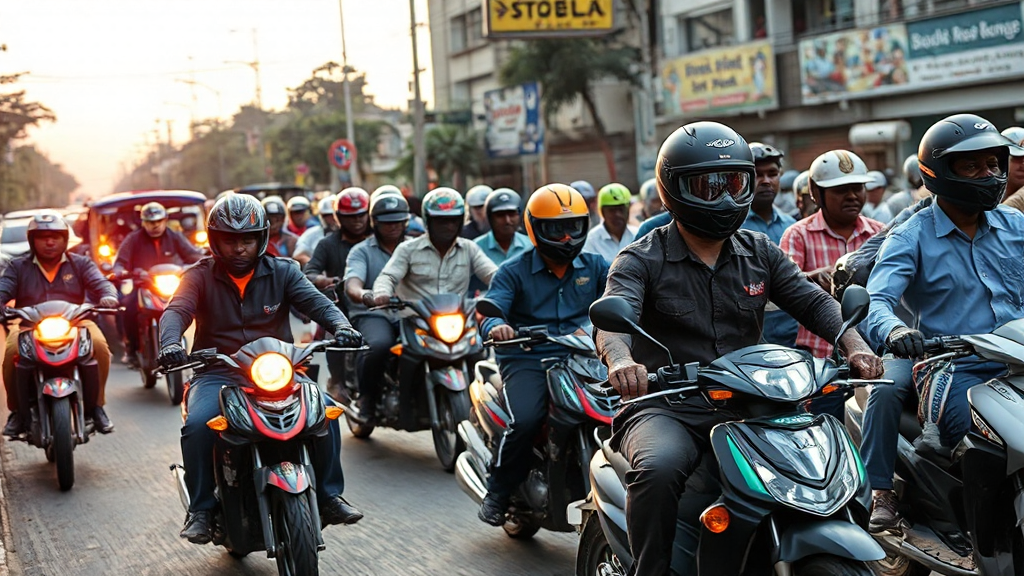
Nairobi Governor Johnson Sakaja’s administration is facing its most significant public backlash since taking office after a policy proposal to prohibit motorcycle taxis — universally known as boda bodas — from operating within the Nairobi Central Business District ignited street demonstrations, a sit-in at City Hall, and a threat from the Boda Boda Association of Kenya to call a nationwide strike that would paralysesixteen of the country’s forty-seven counties.
The proposal, contained in a county traffic management policy paper circulated to stakeholders last month and confirmed by the Governor’s spokesperson as “under active consideration,” would designate the area bounded by Haile Selassie Avenue, Uhuru Highway, University Way and Ngong Road as a boda boda exclusion zone, effective from January 2027 if approved by the Nairobi County Assembly. Enforcement would rely on Nairobi Metropolitan Services officers and county parking officers supported by CCTV-based number plate recognition technology being installed under the Smart Nairobi programme.
The Governor’s Rationale
The administration argues the ban is a necessary component of Nairobi’s urban transformation agenda. Boda bodas in the CBD have been linked to a significant proportion of the city’s road fatalities — Nairobi recorded 847 road deaths in 2025, the highest in a decade, with motorcycle incidents accounting for 38 per cent — as well as to snatching and mugging incidents that the Nairobi police command says are frequently perpetrated by riders who use the congested, narrow streets around River Road and Tom Mboya Street to evade capture.
“We are building a city that will host the world for the 2028 Olympics pathway events and the 2030 World Athletics Championships,” Governor Sakaja told a Rotary Club breakfast in Westlands. “A capital city that cannot manage its own streets is not a competitive city. Boda bodas have a role to play in Nairobi’s transport system, but not in a zone where we have matatus, buses, pedestrian walkways and cycling lanes all sharing space.”
The administration has proposed designated boda boda terminus points at the edges of the exclusion zone — at Ambassadeur, Railways Bus Station, and the Kencom area — from which operators could collect CBD-bound passengers who would complete their journey on foot or by electric shuttle. A county e-hailing app specifically for boda bodas, integrated with M-Pesa, is being developed to facilitate the re-routing.
A Livelihood Crisis for Riders
For the estimated 34,000 boda boda operators who work in and around the Nairobi CBD, however, the proposal threatens an existential economic shock. Many rely entirely on CBD trip income, particularly the lunch-hour and evening commuter rush that generates the highest fares. The Boda Boda Association of Kenya estimates that an average CBD-active rider earns between Ksh 1,200 and Ksh 1,800 per day, and that exclusion from the zone would reduce earnings by 40 to 60 per cent.
“This governor wants to push us out of the only place in Nairobi where there is business,” said James Omondi, a boda boda operator from Kayole who has worked CBD routes for nine years. “Who will feed my children while we wait at a terminus for passengers who will not come? This is not planning — this is persecution of the poor.”
The protest outside City Hall on Tuesday drew approximately 2,000 riders, who blocked Harambee Avenue for three hours before dispersing after a police warning. The national chair of the Boda Boda Safety Association, Antony Karanja, said that if the county assembly approved the ban without adequate transition support — including subsidised loans for alternative livelihoods, relocation incentives, and a phased implementation period of at least two years — operators would exercise their constitutional right to strike.
Political Dimensions
The controversy arrives in a politically sensitive pre-election environment. Boda boda operators constitute an organised and vocal constituency that no politician seeking urban working-class votes can afford to alienate. Several Nairobi Members of County Assembly representing Eastlands wards have broken publicly with the Governor on the issue, and at least one senior ODM MP has threatened to mobilise riders against the county government if it proceeds without negotiation. National Assembly Transport Committee Chair has summoned CS for Roads Davis Chirchir to address a session on the matter, though jurisdiction between national and county governments on urban traffic regulation remains a matter of legal debate. Governor Sakaja faces a genuine dilemma: back down and look weak on urban governance, or proceed and risk the ire of one of Nairobi’s most politically organised constituencies ahead of 2027.

0 comments