
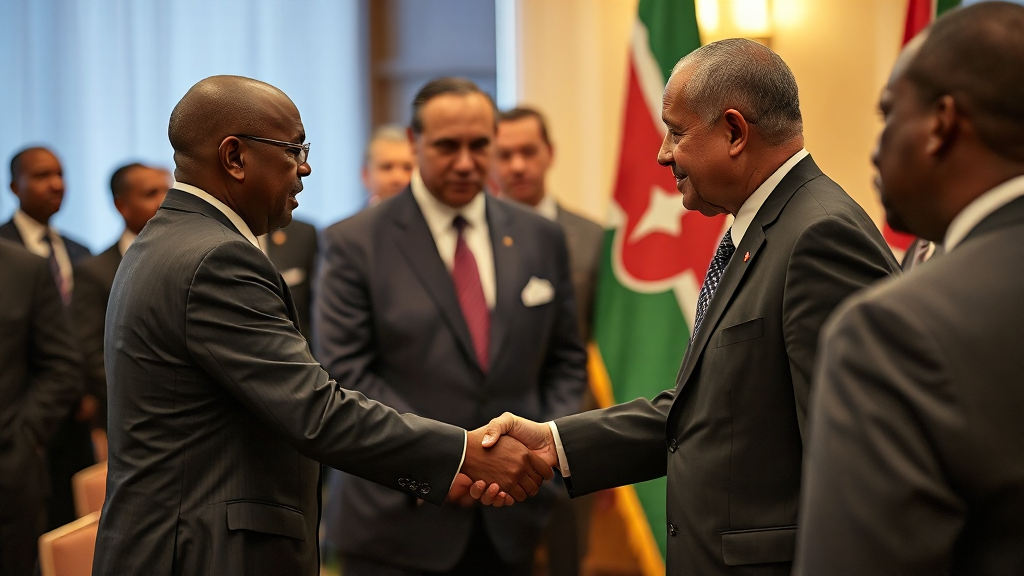
Cabinet Secretary for Foreign and Diaspora Affairs Musalia Mudavadi announced on Wednesday the formal opening of five new Kenyan diplomatic missions, a simultaneous expansion that represents the single largest growth of the country’s overseas presence in a decade and reflects both the ambition and the economic imperatives driving Kenya’s foreign policy under President Ruto’s administration. The new missions are in Riyadh (Saudi Arabia), Jakarta (Indonesia), Doha (Qatar), Dar es Salaam — upgraded from a consulate to a full embassy — and Accra (Ghana), which Kenya had not maintained a resident mission in since 2011.
Mudavadi, speaking at a ceremony at the Ministry’s headquarters on Harambee Avenue, framed the expansion as a direct response to the economic strategy of mobilising foreign direct investment and export market access as alternatives to debt-financed development. “Every embassy is an economic outpost,” he said. “We are not opening these missions for protocol. We are opening them to increase Kenyan exports, attract investment, protect our diaspora, and build the south-south partnerships that will define the next century of Kenya’s development.”
The Strategic Logic
The choice of locations reflects careful prioritisation. Saudi Arabia and Qatar together account for over 30 per cent of Kenya’s diaspora remittance inflows — projected to reach Ksh 640 billion in 2026 — yet until now Kenya’s Gulf diplomatic infrastructure was limited to a single embassy in Abu Dhabi that was formally accredited to both UAE and Saudi Arabia. The Riyadh and Doha missions will also serve as platforms for pursuing Gulf sovereign wealth fund investment in Kenya’s infrastructure pipeline, including the planned Lamu-Isiolo highway and Nairobi metro rail extension, both of which require external financing.
The Jakarta mission targets South-East Asia’s largest economy and a country with which Kenya has largely untapped complementary trade potential: Kenya’s tea, coffee, avocado, and macadamia sectors could access Indonesia’s 270-million-person consumer market, while Indonesian palm oil and electronics manufacturers have shown interest in the East African market through Kenya’s EAC gateway. The two countries signed a bilateral trade agreement in principle during President Joko Widodo’s 2023 Nairobi visit, but implementation has stalled partly owing to the absence of resident diplomatic representation.
The Dar es Salaam upgrade is perhaps the most geopolitically significant. Relations between Kenya and Tanzania have experienced periodic friction over trade barriers, transit fees, and competition for regional business hub status. Elevating the Dar es Salaam mission signals Nairobi’s intention to prioritise the relationship at the highest diplomatic level as EAC integration deepens, and as the two countries compete for the affections of foreign investors who increasingly view the Nairobi-Dar corridor as a single investment destination.
Diaspora Services Under Scrutiny
The announcement was welcomed by Kenyan diaspora associations in all five locations, with particular enthusiasm in the Gulf where community members have long complained of inadequate consular services during labour disputes, imprisonment, and emergency repatriation situations. The Kenyan Workers in the Gulf Coalition, which represents an estimated 180,000 Kenyans in Saudi Arabia and Qatar, issued a statement cautiously praising the missions’ opening while demanding that they be adequately staffed and funded. Past expansions have seen new missions opened with skeleton staff of two or three officials and insufficient resources to handle the case volumes generated by large diaspora communities.
The Foreign Affairs ministry has committed Ksh 3.4 billion in the current financial year to staffing and operationalising the new missions, drawn partly from a reallocation within the diplomatic budget and partly from the Diaspora Development Fund established in 2024. Critics in Parliament have questioned whether this represents adequate resourcing, noting that Kenya’s existing missions in London and Washington remain under-staffed relative to the demands placed on them.
Kenya’s Global Positioning
The embassy expansion is part of a broader diplomatic activation that includes Kenya’s candidacy for a non-permanent seat on the UN Security Council for the 2027-2028 term, its leadership of the Haiti peacekeeping mission, and Nairobi’s growing reputation as a hub for international organisations, with the UN Environment Programme, UN-Habitat, and over 50 other multilateral bodies headquartered in the city. CS Mudavadi has spoken publicly about Kenya’s ambition to establish itself as Africa’s diplomatic capital — a role it shares informally with Addis Ababa and Johannesburg but has not yet formally claimed. These five embassies, modest as they may appear in isolation, are part of that larger project.

0 comments