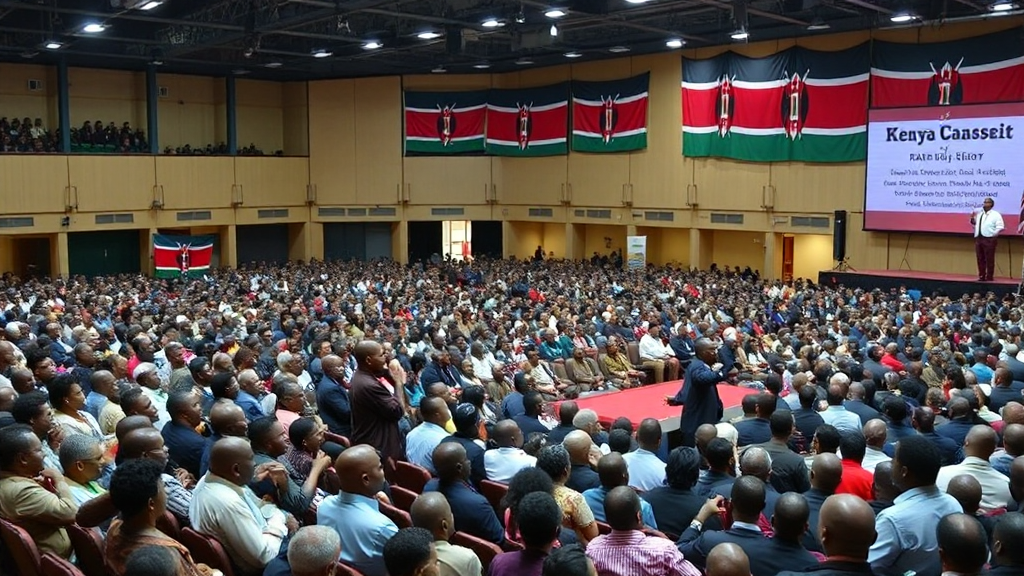
The Orange Democratic Movement concluded its five-day national delegates’ conference in Kisumu this week having produced the most detailed and costed policy platform the party has released since its founding, a document its leadership says will serve as the bedrock of a 2027 general election campaign premised on reversing what ODM frames as the economic and governance failures of President Ruto’s administration.
The conference, held at the Lake Basin Mall convention facility and attended by over 3,200 elected delegates from all 47 counties, also resolved a number of internal structural questions that had complicated the party’s positioning since party leader Raila Odinga’s appointment as African Union Commission Chairperson in February 2025. Deputy party leader Wycliffe Oparanya chaired proceedings in Odinga’s absence, though the former Prime Minister addressed delegates via video link from Addis Ababa for a 40-minute session that generated the loudest applause of the week.
The Policy Blueprint
The document, titled ‘Kenya Mpya: Agenda for Shared Prosperity,’ runs to 87 pages and is organised around six thematic pillars: economic revival, healthcare and social protection, education and youth, agriculture and food security, governance and anti-corruption, and devolution strengthening. Key headline commitments include reversing the affordable housing levy on salaries below Ksh 50,000, completing the transition to universal health coverage under a reformed SHA framework with reduced co-payment requirements for low-income households, and creating a Youth Employment Guarantee Scheme targeting one million jobs over five years.
On the economy, the platform takes direct aim at the IMF austerity conditions that have constrained public spending under Ruto. ODM’s shadow finance team, led by former Kisumu Senator Tom Ojienda, proposes a renegotiation of Kenya’s IMF Extended Fund Facility to shift conditionalities away from regressive taxation and towards capital efficiency measures. Economists contacted by ZaKenya were sceptical: Dr Josphat Gachanja of the Kenya Institute for Public Policy Research noted that “no government has successfully renegotiated core IMF structural benchmarks mid-programme without triggering a credit event,” though he acknowledged the political appeal of the argument to a public weary of KRA enforcement actions.
“The people of Kenya did not vote for austerity. They voted for a bottom-up economy and got a top-down tax system,” Oparanya told delegates to sustained applause. “ODM will build an economy that works for the mama mboga, the boda boda rider, and the Gen Z graduate who cannot find a job.”
The Leadership Question
The conference deliberately avoided naming an ODM presidential candidate, reflecting both the complexities of Odinga’s AU role — which formally prevents partisan political activity — and the broader coalition arithmetic that ODM hopes to assemble before 2027. Internal party polling, shared with delegates in a closed session, shows ODM’s vote base concentrated in Nyanza, Western, and the Coast, commanding roughly 28 per cent of the national electorate in isolation. Coalition partners will be essential.
Names in circulation include former Deputy Chief Justice Philomena Mwilu, Kilifi Governor Gideon Mung’aro, and former Nairobi Governor Mike Sonko, though the last was firmly rejected by several women delegates who cited his legal history. A party spokesperson confirmed that formal presidential candidate selection will begin in the first quarter of 2027, following a membership drive targeting two million new registered supporters.
Youth Engagement at the Centre
Recognising that the Gen Z political awakening has created an electorate that is sceptical of party loyalty and transactional politics, the conference established a new ODM Youth Policy Council with real influence over the manifesto drafting process. Twenty-four youth delegates under the age of 35 were elected to the council, and the party committed to reserving 40 per cent of its candidate slots for the 2027 parliamentary elections for young people.
“We understand that the young people of Kenya are watching us with different eyes,” said Martha Karua’s former running-mate, who addressed the conference as a guest speaker. “They do not want slogans. They want structures, accountability, and proof that their vote produces change.” Whether ODM can translate a credible policy document into electoral victory will depend as much on coalition-building and the final candidate field as on the quality of the ideas in those 87 pages.

0 comments