
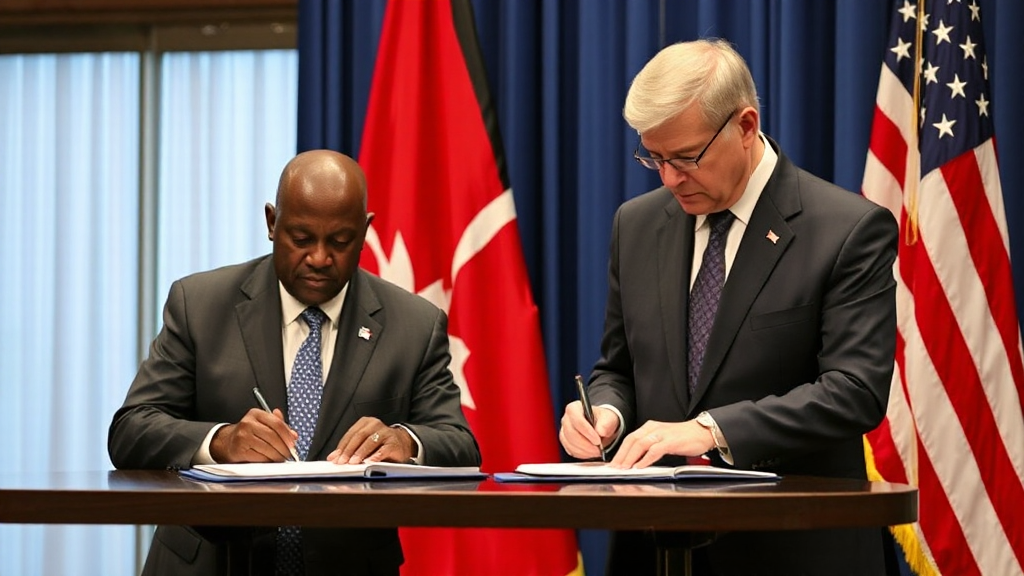
Kenya and the United States signed a landmark Enhanced Security Cooperation Framework in Nairobi on Thursday, formalising what both governments described as the most comprehensive bilateral defence and intelligence partnership in the history of the relationship between the two countries. The agreement, signed by Cabinet Secretary for Defence Aden Duale and visiting US Secretary of State Marco Rubio, covers counterterrorism intelligence-sharing, joint training programmes, cybersecurity cooperation, and a fresh tranche of military hardware transfers valued at approximately 230 million US dollars.
The signing comes at a moment of renewed urgency. Al-Shabaab’s cross-border attacks into Kenya’s north-eastern counties have escalated in frequency over the past eighteen months, with 14 separate incidents recorded between January and June 2026 in Mandera, Wajir, and Lamu counties, killing 47 Kenyan security personnel and 23 civilians. A particularly lethal ambush in Wajir County in March, which claimed the lives of 11 Kenya Defence Forces soldiers, prompted emergency security reviews and accelerated the diplomatic timeline for the new framework.
What the Agreement Contains
Beyond the headline military assistance, the framework establishes a Joint Intelligence Fusion Centre to be housed at Kenya’s National Intelligence Service headquarters in Nairobi, staffed by personnel from both countries and equipped with US-provided signals intelligence technology. American officials say the centre will significantly improve the speed at which actionable intelligence on al-Shabaab movements is shared with Kenyan commanders in the field.
The deal also creates a fast-track channel for Kenya to procure additional armed surveillance drones, building on the country’s existing fleet of Israeli-made Heron UAVs. Three new US-manufactured Predator MQ-9 variants are included in the current transfer, with delivery expected before the end of the calendar year. Separately, the US will fund a training programme at the Eldoret-based Kenya Military Academy for 400 counter-IED specialists over three years.
“This agreement is not merely about hardware,” Secretary Rubio said at a joint press conference at the US Ambassador’s residence in Gigiri. “It is about building the institutional capacity of a partner nation that has been on the front line of the fight against extremism in East Africa for decades. Kenya’s sacrifices have been immense. America stands with Kenya.”
Regional Context and Sensitivities
The agreement has generated nuanced reactions across the region. Ethiopia, whose relations with Nairobi have been complicated by the Nile water dispute and the ongoing Tigray reconstruction period, issued a diplomatic note expressing concern about “militarisation of the sub-region without adequate multilateral consultation.” Somalia’s Federal Government, whose own partnership with the US is a pillar of the anti-Shabaab campaign, welcomed the Kenya deal as complementary to the broader ATMIS transition framework.
Kenya’s peacekeeping contribution in Haiti — which has seen over 1,000 KDF and National Police Service personnel deployed since 2024 under a UN mandate — also featured in the discussions, with Rubio acknowledging Kenya’s extraordinary commitment to global security at a time when many nations have retrenched. The US agreed in principle to provide additional logistical support for the Haiti mission, including air transport capacity.
Human rights organisations raised concerns about oversight provisions. Amnesty International Kenya said the agreement’s intelligence-sharing provisions must be accompanied by clear accountability frameworks to prevent abuses of the kind documented during previous counterterrorism operations in Mandera and Lamu, where civilian communities experienced forced displacements and extrajudicial killings attributed to security forces. The agreement text, portions of which remain classified, is said to include a human rights conditionality clause, though its enforcement mechanisms have not been publicly detailed.
Domestic Reception
CS Duale, whose tenure at the Defence ministry has been marked by a systematic effort to modernise the KDF’s capabilities, described the agreement as a generational investment. “We are not outsourcing our security to anyone,” he said. “We are building partnerships that make our own forces more capable, more lethal against the enemy, and better equipped to protect Kenyan lives.” Opposition figures broadly supported the security dimensions of the deal while demanding full parliamentary scrutiny of its financial annexures before ratification, as required under Article 211 of the Constitution.

0 comments