
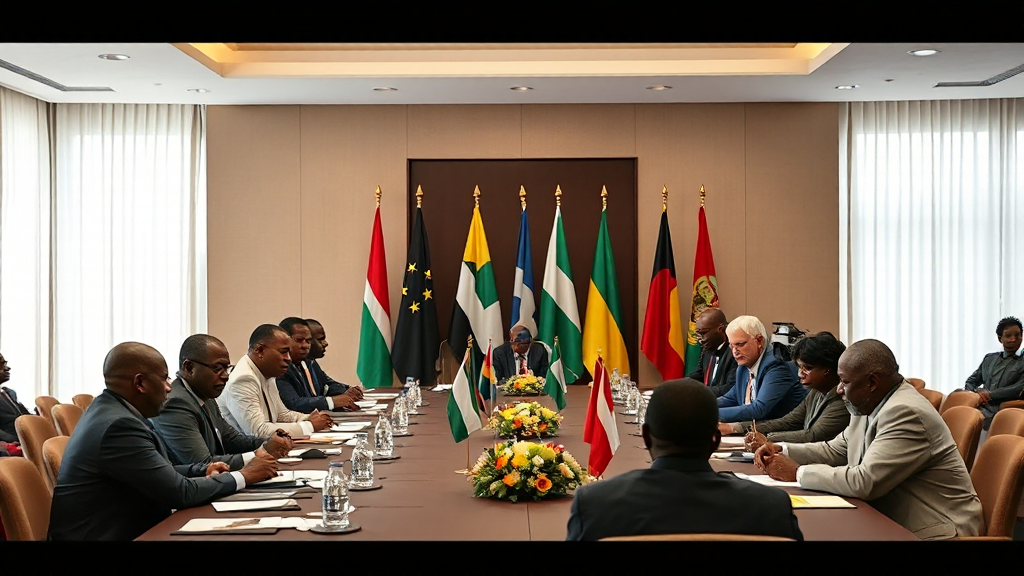
The corridors of the Kenyatta International Convention Centre were thick with the presence of power last week as delegations from 28 African Union member states, the United Nations, the European Union, and the Arab League converged on Nairobi for what AU Commission Chairperson Moussa Faki Mahamat described as “the most consequential gathering on African peace in a decade.” At the centre of it all stood President William Ruto, who spent three days in succession mediating between parties to the Sudan civil war and the eastern Democratic Republic of Congo crisis — two of the continent’s most destructive conflicts — in back-to-back sessions that stretched late into each night.
The two-day summit, formally titled the African Union High-Level Consultation on Continental Peace and Security, concluded on 5 July with the signing of the Nairobi Declaration on Cessation of Hostilities, a framework document committing the Sudanese Armed Forces and the Rapid Support Forces to a 90-day humanitarian ceasefire, and a separate communiqué calling for the immediate withdrawal of foreign-backed armed groups from North and South Kivu provinces in the DRC.
Sudan: Fragile Progress
Progress on Sudan was, by the assessment of most observers, the more unexpected diplomatic achievement. The two-year civil war between SAF General Abdel Fattah al-Burhan and RSF commander Mohamed Hamdan Dagalo, known as Hemedti, has killed an estimated 150,000 people and displaced over 10 million, creating the world’s largest displacement crisis. Previous ceasefire attempts in Jeddah and Geneva had collapsed within days. The Nairobi ceasefire, brokered with the direct involvement of Egypt, Saudi Arabia, and the United Arab Emirates — all brought to the table partly through Kenya’s diplomatic relationships — is structured around a graduated humanitarian access framework with AU monitoring teams to be deployed within 15 days.
“We make no grand claims,” President Ruto told the closing press conference. “A 90-day ceasefire is not peace. But it is the silence in which peace can begin to be built.” His caution was shared by UN Secretary-General Antonio Guterres, who addressed the summit via video link and welcomed the declaration while warning that “words on paper must be converted into actions on the ground within days, not weeks.”
A joint AU-UN monitoring mission of 400 observers, with Kenyan officers forming the largest national contingent, will deploy to Khartoum and Al Fashir immediately following the ceasefire’s entry into force on 15 July.
Eastern DRC: Kenya’s Persistent Engagement
On the DRC file, Kenya’s position as a mediator has been shaped by its years of investment in the Nairobi Process — a track it initiated in 2022 — and by its deployment of troops to the East African Community Regional Force, whose mandate was recently extended through December 2026. The Nairobi Declaration’s DRC communiqué calls on M23 and affiliated groups to withdraw from recently captured territory in South Kivu within 30 days, and establishes a contact group co-chaired by Kenya and Angola to verify compliance.
DRC President Felix Tshisekedi, attending in person, expressed cautious optimism but noted that three previous withdrawal timelines had been missed. Rwanda’s representative — Kigali’s alleged support for M23 remains a source of deep regional tension — signed the communiqué but issued a reservation on the monitoring mechanism’s composition. Foreign Affairs Cabinet Secretary Musalia Mudavadi described Kenya’s role as that of “an honest broker with no territorial ambition and deep investment in regional stability.”
Ruto’s Continental Stature
The summit has consolidated Ruto’s emergence as one of Africa’s most active diplomatic operators, even as domestic audiences — with the 2027 election horizon sharpening — watch his foreign travels with increasing scrutiny. His administration has invested heavily in presenting Kenya as a credible neutral party in continental disputes, a posture that draws on the country’s long tradition of peacekeeping, its relatively stable institutions, and Nairobi’s practical advantages as a hub of international organisations. Whether the Nairobi Declaration’s provisions survive contact with the realities on the ground will determine whether that reputation proves durable.

0 comments