
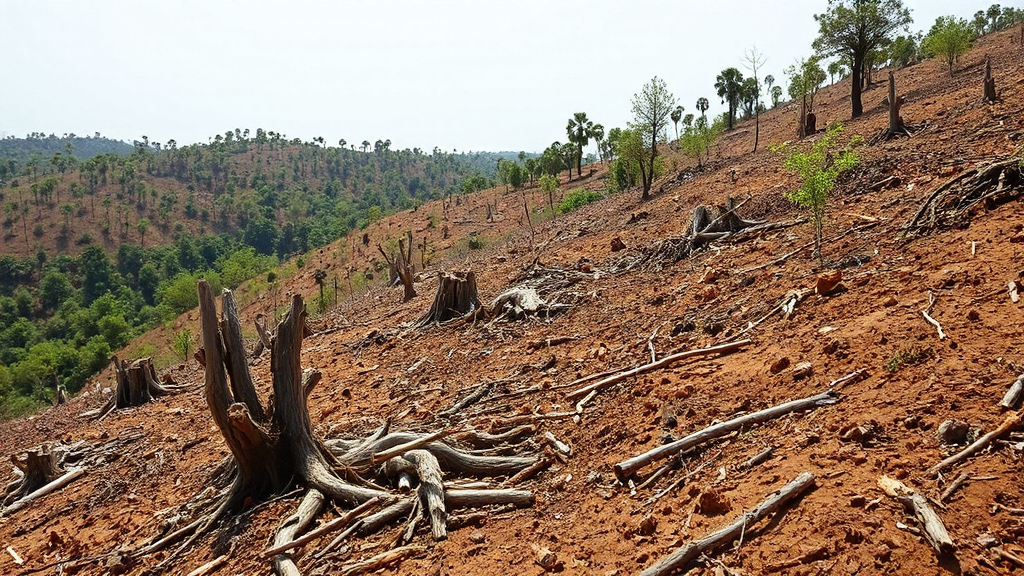
Scientists monitoring Kenya’s coastal forests — a globally recognised biodiversity hotspot that shelters more endemic species per square kilometre than any comparable habitat in Africa — have sounded urgent alarm after satellite analysis revealed that the deforestation rate in these ecosystems doubled between 2020 and 2025. The study, published in the journal Nature Sustainability in June 2026 by researchers from the University of Nairobi, the Royal Botanic Gardens Kew, and the Wildlife Conservation Society, used Sentinel-2 multispectral data to calculate that 14,000 hectares of coastal forest were cleared or severely degraded in 2025 alone, compared with an annual average of 6,800 hectares between 2015 and 2020.
The coastal forests of Kenya — a fragmented archipelago of lowland dry and moist forest patches running from the Shimba Hills near Kwale through Arabuko-Sokoke in Kilifi County to the Boni and Dodori forests in Lamu County — are classified by Conservation International as part of the Eastern Afromontane and Coastal Forests of Eastern Africa biodiversity hotspot. They shelter 11 globally threatened bird species found nowhere else, including the Sokoke Pipit, the Clarke’s Weaver, and the Amani Sunbird. Of the 630 tree species recorded in these forests, 75 are endemic to the East African coast.
Drivers of Accelerating Loss
The study identifies five interlocking drivers of the acceleration. First, charcoal production for Mombasa and the wider coastal urban market has intensified as liquefied petroleum gas prices rose sharply following currency depreciation and fuel subsidy removal under the IMF fiscal programme. An estimated 4.2 million bags of charcoal — each representing approximately one large hardwood tree — were sold in coastal markets in 2025, according to KFS data. Second, small-scale agriculture expansion by landless households, many of them displaced by coastal real estate development for tourism, has pushed cultivation deeper into forest margins.
Third, timber poaching for high-value hardwoods — particularly African blackwood (Dalbergia melanoxylon) and copal (Hymenaea verrucosa) — has surged, partly linked to export networks routing timber through Mombasa Port. KFS rangers made 217 timber smuggling arrests in Kilifi and Lamu counties in 2025, but acknowledged that prosecution rates remain low due to court backlogs. Fourth, invasive species, particularly the introduced shrub Lantana camara, are converting forest understoreys into impenetrable monocultures that suppress tree regeneration even where canopy cover appears intact. Fifth, irregular rainfall associated with post-El Niño climate variability has increased fire frequency in the drier Boni and Dodori forests, with 12 significant fires recorded in 2025.
The Arabuko-Sokoke Crisis
Arabuko-Sokoke Forest — at 6,000 hectares the largest remaining coastal forest patch and the site of the world’s most significant Clarke’s Weaver nesting colony — is under particular stress. KFS aerial surveys conducted in April 2026 showed that the forest’s legal boundary had been encroached upon at 34 separate points, with a total of 320 hectares inside the gazetted boundary converted to farmland or settlement. An illegal logging syndicate dismantled in March 2026 by a joint KFS-DCI operation was found to have extracted timber worth an estimated Ksh 28 million from the forest’s interior over an 18-month period.
“Arabuko-Sokoke is irreplaceable. If we lose it, we lose species that exist nowhere else on earth. That is permanent,” said Dr. Colin Jackson of BirdLife International’s Kenya programme, one of the Nature Sustainability study’s co-authors. “The deforestation rate we are now seeing is incompatible with the survival of the Clarke’s Weaver as a species.”
Kenya Forest Service director Alex Lemarkoko acknowledged the findings and announced an emergency management review of all 14 coastal forest gazetted areas, pledging to table a Coastal Forests Emergency Conservation Bill before the National Assembly by September 2026. The bill proposes enhanced penalties for forest boundary violations — raising the maximum fine from Ksh 100,000 to Ksh 1 million and introducing mandatory minimum custodial sentences for repeat offenders — and allocates Ksh 1.8 billion for ranger recruitment, boundary demarcation, and community forest enterprise development. Whether the legislative response can match the pace of forest loss is a question that scientists say admits no delay. “Every year that passes without decisive enforcement,” said Dr. Jackson, “is a year we do not get back.”

0 comments