
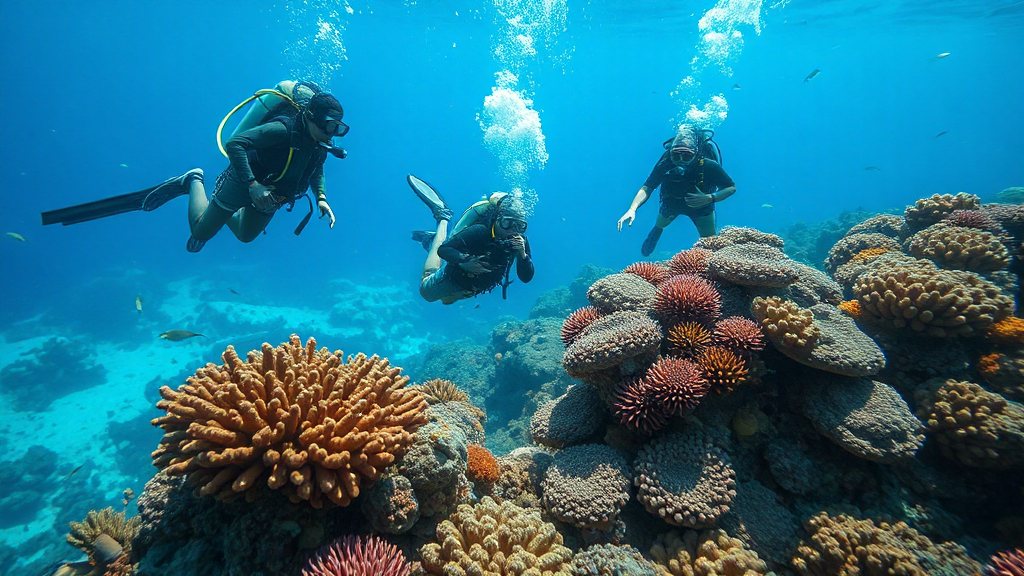
Kenya has won the United Nations Environment Programme’s prestigious Champions of the Earth award in the Ecosystem Restoration category for 2026, with the prize going to the Kenya Coral Reef Restoration Alliance — a network of fishing communities, county governments, marine research institutions, and NGOs that has planted over 180,000 coral fragments across 28 reef sites along the country’s 600-kilometre Indian Ocean coastline. The award was announced at UNEP’s annual Nairobi headquarters ceremony on 5 June, World Environment Day, and was accepted jointly by KCRRA co-ordinator Fatuma Ali Dida and Kenya Marine and Fisheries Research Institute director Dr. James Njiru.
The Champions of the Earth award, launched in 2005 and previously won by figures including Wangari Maathai and organisations from Costa Rica, Bhutan, and Norway, is widely regarded as the United Nations’ highest environmental honour. Kenya’s win marks the first time the award has been given specifically for coral reef restoration in the Western Indian Ocean region and the third time a Kenyan entity has received it, following Maathai’s 2004 win and the Kibera composting programme’s 2011 recognition.
How Kenya’s Reef Restoration Works
The Alliance’s methodology, developed over seven years and now replicated in Tanzania and Mozambique, centres on what practitioners call the “coral nursery to reef” pipeline. Coral fragments, harvested from healthy parent colonies in deep-water refugia zones where temperatures are buffered against surface warming, are attached to purpose-built underwater nursery trees — metal frames anchored at 6–10 metres depth in lagoon waters protected from wave action. After six to eight months of monitored growth, when fragments reach optimal size, trained community dive teams transplant them to degraded reef structures using stainless steel pins and calcium carbonate cement.
The programme employs 340 community divers drawn from Shimoni, Wasini, Gazi, Diani, Watamu, Malindi, and Kiunga fishing villages — men and women who grew up on these reefs and watched their bleaching and physical destruction from anchor damage, destructive fishing, and sewage pollution over three decades. Each community team maintains its own nursery site and reef transplant zone, creating a proprietorial relationship that has dramatically reduced instances of anchor damage and illegal dynamite fishing in Alliance zones. “When the reef is yours to nurse, you guard it like your children,” said Ali Hassan Mwakio, a Shimoni-based dive coordinator who has been with the programme since its 2019 pilot phase.
Results, Scale, and Climate Stakes
KMFRI monitoring surveys show that transplanted coral plots in the programme’s oldest sites — Malindi Marine National Park and the Kisite-Mpunguti Marine Protected Area near Shimoni — have achieved live coral cover of 35–48 per cent, against a baseline of 8–14 per cent when restoration began. Fish biomass within restored zones is 2.3 times higher than in adjacent unrestored reef sections, according to KMFRI’s 2025 ecological survey, and herbivorous fish species critical to reef health — parrotfish, surgeonfish, and rabbitfish — have returned to functional population densities.
The economic case for reef restoration is stark on Kenya’s coast, where 60,000 artisanal fishing households and a marine tourism industry earning Ksh 42 billion annually depend on reef-associated species. A 2024 World Bank study estimated that Kenya’s degraded reefs were costing the coastal economy Ksh 11 billion per year in foregone fish production and tourism revenue, against a restoration investment that KCRRA has valued at Ksh 1.4 billion over seven years. The return on investment calculus has helped attract private sector co-funding from Safaricom’s ESG programme and three international hotel chains operating on the Kenyan coast.
Climate change remains the reef’s existential threat. The 2024 mass bleaching event, triggered by Indian Ocean sea surface temperatures 1.8°C above baseline, killed an estimated 22 per cent of shallow coral cover in Kenyan waters — partially reversing three years of restoration gains at some sites. The Alliance’s response was to intensify the collection of thermally tolerant coral genotypes identified through genetic screening partnerships with the Australian Institute of Marine Science, creating what scientists call an “assisted evolution” approach to building heat-resistant reefs. UNEP cited this adaptive innovation explicitly in its award citation. “Kenya is not just planting corals — it is building reefs that can survive the ocean that is coming,” said UNEP Executive Director Inger Andersen at the ceremony.

0 comments