
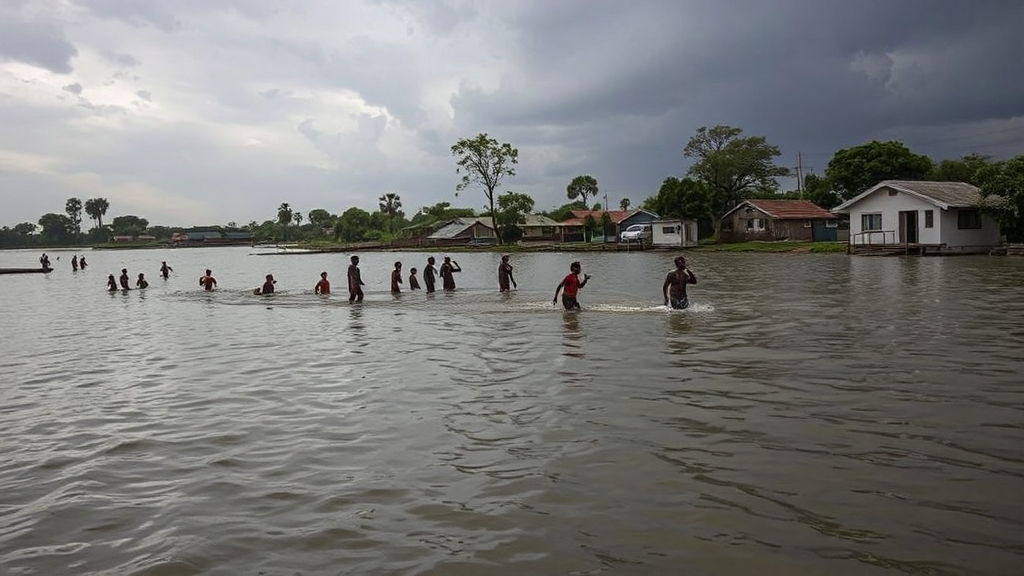
Floodwaters surging down the Tana River have displaced approximately 40,000 residents across Tana River and Garissa counties since mid-June 2026, destroying over 8,000 homesteads, submerging at least 12,000 hectares of smallholder farmland, and killing at least 23 people, according to figures released by the National Disaster Management Authority on 29 June. The crisis, which relief workers are describing as the worst Tana River flooding event since 2019, has overwhelmed county emergency capacity and prompted the national government to declare the two counties disaster zones, unlocking Ksh 1.2 billion in emergency relief funding.
The immediate trigger was an unusually intense sequence of rainfall events in the Mount Kenya and Aberdare ranges — the headwaters of the Tana system — during June 2026, which deposited an estimated 340 per cent of normal monthly rainfall in a 12-day period. Hydrologists at the Kenya Meteorological Department say the pattern is consistent with the erratic, high-intensity rainfall episodes increasingly documented in the aftermath of the El Niño cycle that disrupted the region in 2023 and 2024. “El Niño itself has passed, but it has reconfigured the atmosphere in ways that make these extreme precipitation events more probable and more intense,” said Dr. David Gikungu, Director of the KMD. “What we used to call a once-in-twenty-years event is now occurring every three to five years.”
On the Ground: Communities Cut Off
In Hola, the administrative headquarters of Tana River County, floodwaters reached 1.4 metres above the ground floor of the district commissioner’s offices on 22 June, the highest level recorded at that gauge station. The Garsen–Lamu road, a critical artery linking the lower coast with the country’s interior, was impassable for six consecutive days, stranding perishable goods and cutting off medical supply chains to remote health facilities. Kenya Red Cross Society deployed 14 boats for evacuation operations and established 11 temporary displacement camps, the largest at Bura holding an estimated 5,200 people.
For the Pokomo farming communities along the river’s lower banks, the floods have wiped out a maize and sorghum harvest season that had itself been planted late due to irregular short rains. Seasonal farm income losses are estimated by the Food and Agriculture Organisation’s Kenya office at Ksh 800 million. For the rival Orma pastoralist communities on higher ground, whose livestock compete for the same rangeland resources, the flooding has compressed grazing land and heightened tensions that periodically flare into intercommunal violence. County Security Committee chairman Mohammed Golicha confirmed that three cattle-raiding incidents occurred in the second week of June, though no fatalities were reported.
The Adaptation Deficit
The Tana River flooding has reignited a long-standing debate about the seven hydroelectric dams on the upper and middle Tana — Masinga, Kamburu, Gitaru, Kindaruma, Kiambere, Mutonga, and Grand Falls — and their role in flood management. Kenya Electricity Generating Company operates the reservoirs primarily for power generation, and critics argue that dam release protocols during high-inflow events have historically amplified downstream flooding rather than buffering it. KENGEN chief executive Peter Njenga rejected the characterisation, saying reservoir levels had been managed within flood-control operating rules agreed with the Water Resources Authority, but acknowledged that cumulative inflow volumes in June 2026 exceeded the design assumptions of the operating model by 28 per cent.
The National Drought Management Authority’s Tana Basin Flood Risk Reduction programme, launched in 2022 with $45 million in funding from the Green Climate Fund, was intended to build early warning infrastructure, rehabilitate flood control embankments, and relocate the most vulnerable riverside settlements by 2025. An internal NDMA progress report leaked to local media in May 2026 showed that only 34 per cent of the embankment rehabilitation works had been completed and that only 890 of the 4,200 targeted households had been resettled, largely due to land acquisition delays and budget rescissions under IMF-mandated fiscal consolidation.
The Ruto administration, conscious of the political optics with 2027 elections approaching, moved quickly on relief optics. Interior Cabinet Secretary Kipchumba Murkomen visited displacement camps in Hola on 25 June, distributing food rations funded through the Kenya Red Cross and the World Food Programme. But opposition leaders, including Narc-Kenya’s Martha Karua, contrasted the visible relief effort with what she called “a decade of deliberate neglect of the Tana basin’s poor.” For the 40,000 displaced, political positioning matters less than the practical question of when — and whether — they can safely return home.

0 comments