
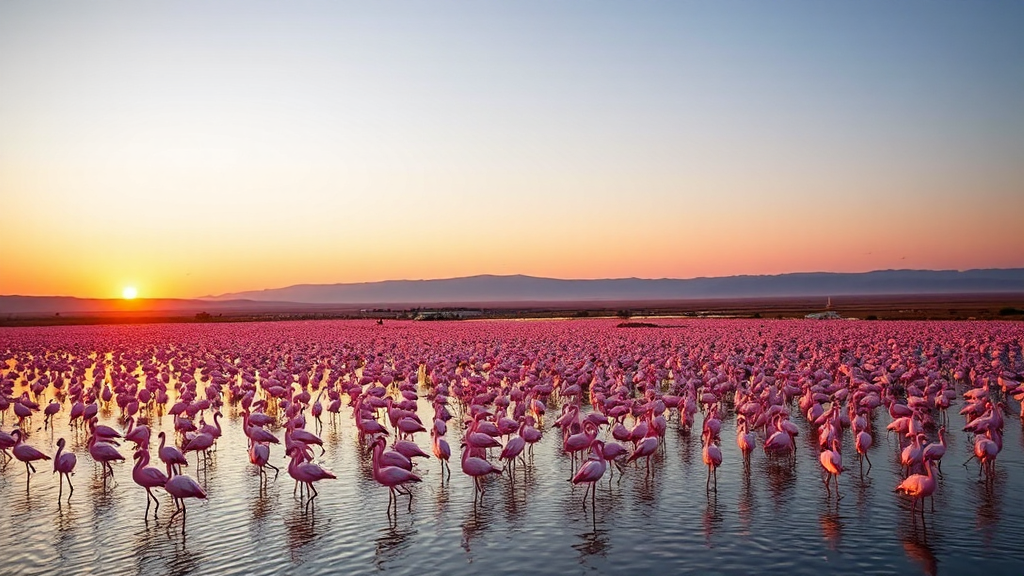
The rose-pink spectacle that defines Lake Nakuru has returned with a force not witnessed since the early 2000s. An aerial census conducted by the Kenya Wildlife Service and Flamingo Watch International in late June 2026 counted approximately 1.23 million lesser flamingos lining the alkaline shores of the Rift Valley lake, the highest single-count figure recorded in 15 years and a dramatic turnaround from the near-total desertion that alarmed ecologists between 2012 and 2018.
The recovery is directly attributed to a three-year water quality rehabilitation programme coordinated by the Nakuru County government, the National Environment Management Authority, and WWF-Kenya, at a combined cost of Ksh 2.8 billion. The programme tackled the principal drivers of flamingo abandonment: industrial effluent from tanneries and flower farms discharged into Njoro River, the lake’s main inflow; untreated sewage from Nakuru town’s rapidly expanding informal settlements; and agricultural runoff carrying pesticide residues that disrupted the bloom of spirulina algae on which lesser flamingos almost exclusively feed.
The Science Behind the Return
Dr. Muchiri Kamau of the Kenya Marine and Fisheries Research Institute, who has monitored Lake Nakuru’s chemistry for two decades, describes the turnaround as “almost miraculous in its speed.” Water sampling data show that conductivity levels, a proxy for the alkaline conditions that favour spirulina growth, have returned to the optimal range of 80,000–100,000 microsiemens per centimetre. Cyanobacteria biomass, measured as chlorophyll-a concentration, rose to 340 milligrams per cubic metre in February 2026, its highest level since 2009. “Flamingos are exquisitely sensitive biological indicators. When they come back in these numbers, nature is telling you the lake is healing,” said Dr. Kamau.
A key intervention was the commissioning of the Nakuru East Wastewater Treatment Plant in August 2025, financed through a Ksh 1.1 billion African Development Bank loan secured under President Ruto’s administration. The plant processes 18,000 cubic metres of municipal sewage daily, a capacity that covers roughly 70 per cent of Nakuru town’s current output. Before its construction, an estimated 12,000 cubic metres of partially treated and raw sewage entered the Njoro River system each day.
Economic and Tourism Implications
The flamingo return has immediate commercial consequences for Nakuru County, whose economy was bruised by both the birds’ absence and the economic disruptions of the El Niño rains that caused severe flooding in the Rift Valley in late 2023 and early 2024. Lake Nakuru National Park recorded 198,000 visitors in the first quarter of 2026, a 67 per cent increase on the same period in 2025, driven largely by the flamingo resurgence. The park’s gate revenues of Ksh 1.4 billion in Q1 2026 surpassed the full-year total for 2023.
Governor Susan Kihika announced an accelerated upgrade of the park’s road network and visitor facilities to manage the influx sustainably, allocating Ksh 480 million from the county’s 2026/2027 budget. Boutique safari lodges along the lake’s western fringe, several of which had closed during the flamingo lean years, are reopening with new investment. “We are looking at Nakuru becoming a top-five park destination again, and the county government is determined to build the infrastructure worthy of that status,” said Governor Kihika.
Conservationists are cautiously optimistic but stress that the lake’s recovery remains fragile. The Njoro catchment still has dozens of unregistered small-scale tanning workshops and unlicensed agrochemical depots whose effluent bypasses treatment. NEMA has served enforcement notices on 34 facilities since January 2026, but NGO monitors say compliance remains patchy. The flower farm sector, which exports Ksh 120 billion in cut flowers annually and relies heavily on fertilisers with high phosphorus loads, is in ongoing negotiations with NEMA over a new voluntary effluent code.
For the flamingos themselves, population dynamics remain complex. Lesser flamingos move fluidly between Lakes Bogoria, Elementaita, and Nakuru depending on food availability. Bogoria’s own spirulina productivity has fluctuated as the El Niño aftermath altered Rift Valley rainfall patterns, and scientists believe Nakuru’s improved chemistry partly explains a redistribution of birds that were already present in Kenya rather than a net population increase. “The total East African flamingo population has not collapsed — they moved,” explained Dr. Lucy Wairimu of BirdLife International’s Kenya programme. “Nakuru calling them home is good news regardless of the mechanism.”

0 comments