
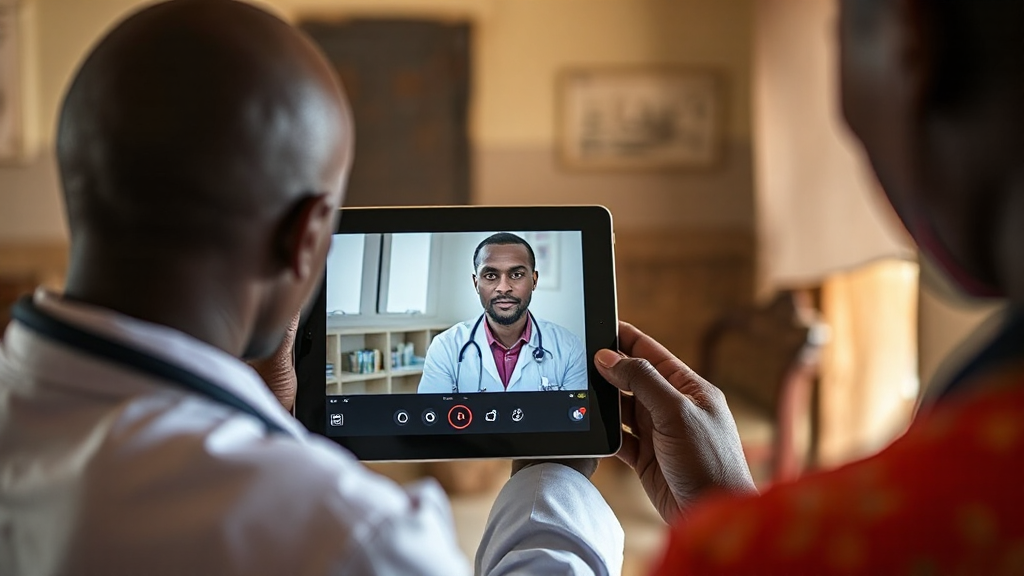
The number of telemedicine consultations conducted through Kenya’s national health system has risen by 200 per cent in the twelve months to June 2026, according to Ministry of Health data — a surge driven not by urban technology adoption but by a quiet revolution in rural connectivity that is fundamentally changing how millions of Kenyans access specialist care. At the heart of the shift is the Universal Connectivity for Health initiative, a public-private partnership that has installed satellite internet terminals at 1,340 rural and peri-urban health facilities since its launch in October 2024.
The programme, co-funded by the government and a consortium including Safaricom, Telkom Kenya, and international development partners, provides each facility with a 50 Mbps symmetrical satellite connection capable of supporting high-definition video consultations, real-time digital x-ray transmission, and integration with the SHA’s electronic claims processing system. Where previously a nurse at a dispensary in Lamu’s hinterland might spend three days attempting to reach a specialist by telephone — often relying on a shared mobile phone with patchy network coverage — they can now initiate a video consultation with a physician at a referral hospital within minutes.
Numbers That Tell a Story
In the 2024-2025 financial year, the national health information system recorded 412,000 telemedicine consultations across all participating platforms. In the first five months of 2026 alone, that figure had already reached 620,000, with the Ministry projecting the year-end total will approach 1.5 million. The most consulted specialties are dermatology, mental health, orthopaedics, and ophthalmology — disciplines where image or video transmission adds significant diagnostic value over a voice call and where specialist shortages are most acute in rural settings.
Mental health has emerged as a particularly striking success story. Kenya has approximately 100 psychiatrists for a population of 58 million. Before telemedicine connectivity, patients in rural counties requiring psychiatric assessment faced waits of up to eight months for an in-person appointment at a referral hospital. The Mathare National Hospital’s telepsychiatry programme, now linked to 340 rural facilities, completed over 28,000 remote psychiatric consultations in the first half of 2026, with prescriptions transmitted electronically to the nearest accredited pharmacy through the SHA drug dispensing network.
Safaricom’s Role and 5G’s Promise
Safaricom’s expanding 5G network — now live in Nairobi, Mombasa, Kisumu, Nakuru, Eldoret, and Thika — provides the backbone for urban telemedicine infrastructure, while the satellite connectivity programme addresses the last-mile challenge in areas where ground-based 4G coverage remains incomplete. The integration of M-Pesa’s digital payment infrastructure into telemedicine billing has been particularly significant: patients can pay consultation fees or access SHA co-payment waivers through the same M-Pesa ecosystem they use for daily transactions, dramatically reducing friction in the payment journey and improving facility revenue collection.
Dr. James Macharia, the Ministry of Health’s Director of Digital Health, said the connectivity programme had exceeded expectations. “We budgeted for 1,000 facilities by end of 2025 and reached 1,340 ahead of schedule,” he told ZaKenya. “The usage data show that once you give a facility connectivity, utilisation rises within weeks. Nurses and clinical officers are entrepreneurial. They find the use cases. They start calling Nairobi Hospital for a second opinion on an ECG. They send a dermatology photo to Kenyatta National. The system was always there — it just needed the bandwidth.”
Challenges That Remain
Digital health advocates caution against premature triumphalism. Approximately 15 per cent of satellite-connected facilities report intermittent outages lasting more than 24 hours, partly due to dish alignment issues in high-wind environments and partly due to delays in satellite operator maintenance response. Device availability remains a constraint: fewer than 40 per cent of rural facilities have dedicated telemedicine tablets or computers, with many consultations conducted on clinical officers’ personal smartphones, raising data privacy concerns that the Kenya Health Informatics Association has formally raised with the Ministry.
Training is the other persistent gap. A Ministry audit found that only 62 per cent of clinical staff at connected facilities had received formal training on the telemedicine platforms in use, and just 41 per cent felt confident managing a complex consultation remotely. The government’s response — a 12-week online certification course launched in March and accessible through Kenya’s national e-learning portal — has enrolled 8,000 health workers to date. The target is 25,000 by December. The revolution in rural connectivity is real. Translating it into consistently high-quality care will require sustained investment in the human software, not just the digital hardware.

0 comments