
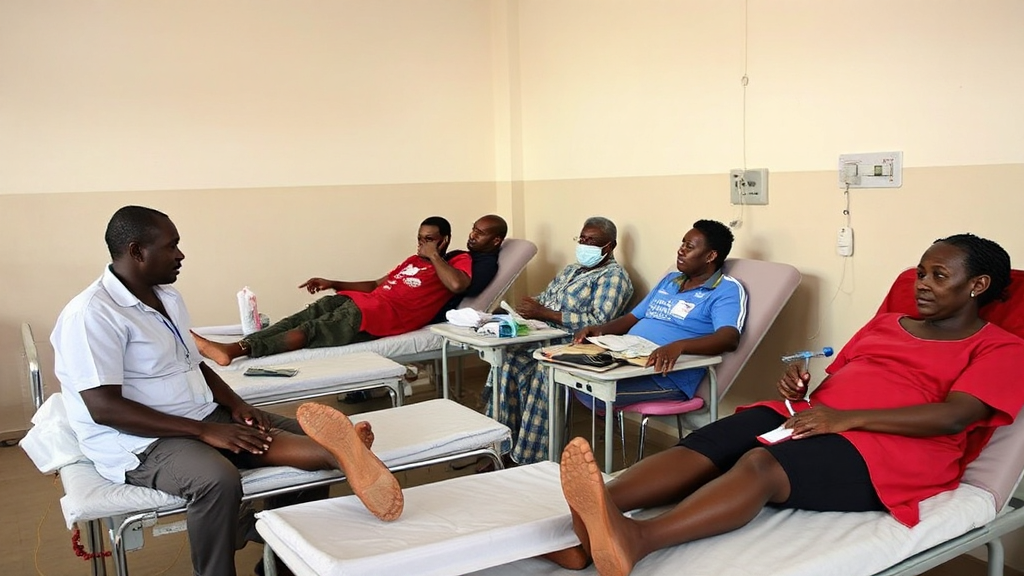
Kenya’s national blood supply has dropped to critically low levels at precisely the moment when demand is set to surge, the Kenya National Blood Transfusion Service (KNBTS) warned in an urgent communiqué issued to county health directors last month. The service currently holds approximately 65,000 units of blood against a safe minimum threshold of 90,000 units — a shortfall of nearly 28 per cent that has prompted emergency appeals to faith-based organisations, universities, and corporate donors across the country.
The timing could not be more fraught. The Social Health Authority’s expanded surgical benefits package, which came into full effect in April 2026, has dramatically increased the volume of elective and semi-elective procedures being booked at county referral hospitals. Orthopaedic surgeries, caesarean sections, and oncological operations — previously deferred by patients unable to afford NHIF co-payments — are now flooding theatre lists. Each of these procedures carries a significant blood transfusion risk, and the KNBTS infrastructure has not scaled to match.
A System Strained at Its Seams
Dr. Margaret Oloo, Director of the KNBTS, said her agency collects roughly 450,000 units of blood annually against a national need estimated at 700,000 units. “We have never reached adequacy,” she said at a press briefing in Nairobi. “But the SHA surgical surge has accelerated the gap. We are now seeing hospitals calling us daily for emergency blood releases, and we are having to ration. That is not a situation any transfusion service wants to be in.”
The regional picture is particularly alarming. Western Kenya’s major hospitals — Jaramogi Oginga Odinga Teaching and Referral Hospital in Kisumu, Kakamega County General, and Kisii Teaching and Referral — between them have recorded a 34 per cent increase in surgical throughput since January. Blood stocks available to the western region currently cover fewer than four days of demand, against a recommended buffer of ten days.
The crisis has been compounded by logistical failures within the cold-chain network. An audit conducted by the Ministry of Health in May found that seven of the 15 regional blood banks maintained below-standard refrigeration conditions, resulting in an estimated 8,000 units being discarded in the first quarter of 2026 alone. Procurement of replacement refrigeration units is pending a Treasury approval that has been delayed by the government’s fiscal consolidation programme under its IMF standby arrangement.
The Donor Gap
Kenya’s voluntary non-remunerated blood donation rate stands at approximately 1.1 units per 100 people annually, below the World Health Organisation’s recommended minimum of 1.5 units. Cultural hesitancy, fear of needles, and misinformation — particularly the persistent myth that donated blood is sold commercially — continue to suppress participation. The KNBTS’s social media campaigns, boosted in partnership with Safaricom’s internal communications network to reach M-Pesa users, have yielded modest gains but not at the scale required.
Youth-led civic organisations, energised by the Gen Z political awakening that reshaped Kenya’s public discourse following the 2024 protests, have begun mobilising donation drives on university campuses. Students at the University of Nairobi, Kenyatta University, and Moi University collectively donated over 12,000 units in June, a record for a single month driven largely by social media coordination through platforms including X and TikTok.
Structural Solutions Needed
Health experts argue that voluntary campaigns alone cannot close a structural gap that requires systemic investment. Proposals under consideration include integrating blood donation check-in points at Huduma Centres, linking donation records to the SHA digital health identifier to offer priority outpatient queuing benefits, and mandating blood donation as a component of the National Youth Service curriculum. A parliamentary committee on health is scheduled to hear testimony on the crisis in the coming weeks, with cross-party support emerging for a dedicated emergency blood infrastructure allocation in the supplementary budget. For patients awaiting surgery at Kenya’s referral hospitals, the urgency is absolute.

0 comments